Thursday, August 28, 2025

ELEMENTARY RUSSIAN: Lab Unit 1 Week 2 Numbers and reduction)

Welcome back to the lab!


Здравствуйте, студенты! Вы знали, что первое сентября - День знаний в России? = Hello, students! Did you know that the first of September is Knowledge Day in Russia (when the school starts)...

Q. Where is День знаний celebrated?
День знаний по-прежнему отмечается в разных странах: в Белоруссии, Казахстане, Кыргызстане, Армении и Латвии. (See if you can figure out the countries where it's still celebrated as it was in the USSR.) I don't think most schools for most grades have classes, per se. It's more of a party: The kiddos march in groups, the teachers get flowers, fireworks, speeches are speeched. That sort of thing. The event figures large in the imaginations of children, to be sure.

This short video is a glimpse of how they celebrated the first of September 2021 in one of the Moscow schools. Can you hear the name and the patronymic of the teacher? Ask me about this video if you have any questions ...


Can you read the cursive below? It says ВСЁ БУДЕТ ХОРОШО! = Everything will be OK!


Сначала! First: Grab a worksheet for today= хендаут!  


1) On a computer or heck even your PHONE, listen to & start learning the cardinal numerals 11-20. The numbers (Числительные) exercise is on the LL handout. If you're feeling confident, try to write the numbers out in words, not figures! (Links are below.) 
11 Одиннадцать 
12 Двенадцать 
13 Тринадцать 
14 Четырнадцать 
15 Пятнадцать 
16 Шестнадцать 
17 Семнадцать 
18 Восемнадцать 
19 Девятнадцать 
20 Двадцать 

Listen to the Числительные (Numbers) exercise here


Write down the numbers you hear here on your handout.

2) Now, listen to the three “разговоры” (conversations) and answer the questions. (Links below.) Don't worry that you cannot understand everything!!! Get used to it. Just jot down the responses, to the best of your ability, directly on the LL handout wherever there's room next to the corresponding questions. Remember: We listen to a lot of Russian in this class to train your ear. How can we train your ear if we only listening to stuff you understand? Here are some suggestions how to proceed:
  • Read the questions in the handout first
  • Listen to the whole conversation to get the gist of it.
  • Look out for words that sound familiar (the names of the US states for instance)
  • Keeping the questions in mind, listen to the conversation again for more details.
  • Listen one more time (3-4 times would be enough). Don't worry if you don't understand everything. (This cannot be overemphasized! 

Listen to the разговоры here: 


3) With a partner (or me! Or the tutor! or by your lonesome dove!) read the Доброе утро dialogue on the LL handout. 


Can you read cursive above? :) It says:
лишишься... 


Wednesday, August 27, 2025

SECOND YEAR RUSSIAN Unit 1 LAB 2


ЗДРАВСТВУЙТЕ! 

ДАВАЙТЕ ПОРАБОТАЕМ!

Now, Возьмите хендаут ЗДЕСЬ! = Get today's  handout at the link above or grab a printed copy from us!


OK... Давайте послушаем! Two SHORT listening exercises о погоде в Москве и о погоде в Петербурге. Listen to these forecasts (just half of the recording!) и ответьте на пару вопросов... Answer a couple of questions on the worksheet... (That's 1-50 and 1-51 on the handout.)

Now, I'd like you to choose any dialogue out of the three dialogues in the handout and read it aloud... then translate... then read it again. Mark the one of your choice, we'll work on them more on Tuesday.

Then there is a brief grammar exercise (see the handout)

The exercise trains your use of the preposition к + датильный падеж (dative). The combo means "go to someone's house": Куда ты ходил? Я ходил к Давиду. Wheredya go? I went to David's house.

СПАСИБО ЗА ХОРОШУЮ РАБОТУ!!!!


Tuesday, August 26, 2025

Elementary Russian: Сегодня! Today in the Lab, Unit 1 Week 1....

Добро пожаловать в лингафонную общину!!

Welcome to Elementary Russian in the Language Commons!

Today we're working on some basic competencies like handwriting, alphabet, listening skills, and counting. You can do this lab in the Language Commons, or wherever. (In case you missed it, here are some resources for learning the Russian alphabet.)

Make sure you have a lab worksheet ! They're available in the lab, or you can print them out for remote work. (Did you know there are free printers all over campus?)

Every lab begins with individual, computer work like watching videos, listening to recordings, etc.

First:

Check out this illustration from Leo Tolstoy's primer, published in the 1870s to help schoolchildren learn to read print and cursive. It's the letter "m" in various typefaces (fonts) and cursive, and a word that readily comes to mind that starts with "m": медведь, bear.


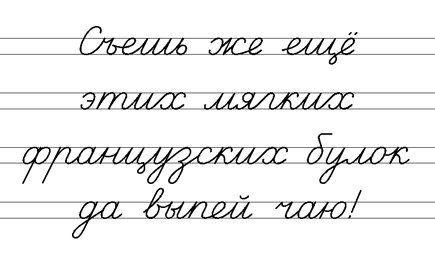
Like English, Russian handwritten (cursive) is somewhat different from print (type). This is how the phrase 
Съешь же ещё этих мягких французских булок да выпей чаю! 

is written out by hand, in cursive. like this:

Eat these soft French buns and drink some tea! 

That's all the letters in the Russian alphabet... probably the shortest iteration, like our "Quick brown fox"... (The word же doesn't really mean anything, it's like, "you know" in English, which mostly doesn't mean "you know." It emphasizes the verb that precedes it, here, "eat", съешь.) A few things to notice: 1) Not many letters are tall, rising above the middle line. 2) Several of the letters (л, м, я) have "hooks" incorporated into their shape that help differentiate them from other letters. 3) Most of the cursive letters look like the print letters, with the real exception of the letter т (tee), which looks like an "m" (examine the word этих, second line, second letter... looks like an "m" doesn't it?) Like English cursive, Russian cursive MOSTLY looks like Russian print. 


You have four short exercises. It should take you 15 minutes. You need to get this worksheet checked... Either by your instructor or a tutor... There are lots of ways to do this, like bringing it to class, finding a tutor, sending it to your instructor by email (take a picture on your phone!), etc. You're smart... you'll figure it out.

Worksheet stuff... 

Do the following on the worksheet. 

Listen to Числительные (Numerals)... Прослушайте! Ех А, Б, В. These are the THREE exercises (first page) on your lab worksheet, starting with the exercise ""You will now learn numbers..." (We know... some of these are just listening exercises and don't require you to write anything... Listening!)

Finished? Закончили? А теперь... And now, Listen to the list of PRIZES! and check off the ones named on your worksheet...

Now, let's do some reading. Go over Alphabet Lesson 4 (you might not be able to do it all today, however, do it by Friday). Send me the screenshots of the last slide from this lesson. 

Handwriting (aka cursive, по-русски пропись)

On the handout you'll find the phrase from above (the one about French rolls), repeated five times with lines that will help you with size and slant. The best way to learn cursive is... you guessed, copying out phrases. The one on your sheet includes all the letters in the Russian alphabet in its shortest iteration. 

WATCH this YouTube series of videos detailing the correct (but not the only way!) to make your буквы (letters)... Some letters are more difficult to perform than others. Here are the most difficult letters to write out:

The letter Кк (kay)

The letter Жж (zhe)

The letter Хх (kh)

The letter Ыы (ee)


Practice copying out the phrase on your worksheet. Watch the videos for help in how to draw them, if you need it. And bring the completed worksheet to class and/or to a tutor or instructor, who can help you out!

If you need help with anything, just give us a shout!


Or reach out to a tutor!  

Monday, August 25, 2025

Second Year Russian: LAB 1 UNIT 1


Лингафонный кабинет. Сейчас август. Добро пожаловать в лингафонный кабинет!

FIRST THINGS FIRST, PRACTICE FOR THE VOCAB QUIZ (10 минут)

Print this lab worksheet . Do all assignments there and have this worksheet checked by me or by tutors before you add it to your portfolio as usual.

Начнём! 

First listen to the numbers in their inflected, genitive form.

Линк на слушание (Numbers in Genitive), А. и Б.

You'll hear выше (higher), ниже (lower), около (about), от (from) до (up to)... These words demand the genitive case of the nouns that follow them. Around five=Около пяти́. (That's the genitive form of the cardinal number five.)

Here are some more genitive forms of numbers...

Oколо ноля (around zero), одного (one), двух (two), трёх (three), четырёх, тридцати́, двадцати́, семи́, тридцати́ пяти́.... It's frustrating that they give you no explanations... But just remember, you're hearing the genitive form of numbers...

Around thirty=Около традцати́. Higher than 18=Выше восемьна́дцати. Lower than 2=ниже двух. (Двух is the genitive form of два, two...)

On your handout, jot down the numbers you hear in Б. Now do the telephone numbers.

Вот... Поняли? Don't get bogged down here with the inflected forms. Part of the point is that you can understand the meaning ("around 5") without understanding the underlying grammar.

***
Что такое безличное выражение? What's an impersonal expression? It's how you say "I'm cold!" Мне холодно! You never say "я холодная" in Russian. say мне холодно
  1. Impersonal sentences in Russian are sentences that don't have a grammatical subject.
  2. In English, impersonal sentences have a grammatical subject, but not a logical one:
              It is very cold in January. 
    The subject, it, in this sentence does not refer to anything or anyone in particular. 
  3. Russian often uses an adverb as the predicate in impersonal constructions:          Здесь холодно. It is cold here          Завтра будет тепло. It will be warm tomorrow.


Russian often uses impersonal construction when describing how a person feels. The person IF EXPRESSED in such constructions will be in the dative case:
  • Мне холодно здесьI feel cold. (Compare the sentence Здесь холодно.)
  • Сергею там было интересно. It was interesting for Sergei there.
  • Наташе здесь будет холодно. Natasha will feel cold here.


Dative Case памятка... 

You'll need to recall the dative forms of the personal pronouns..

Dative CaseМнеТебеЕмуЕйЕму
Dative CaseНамВамИм