Tuesday, November 18, 2014

The Cossacks: The Legendary Fighting Force of Russia with Silly Hats

The Cossacks : The Legendary Fighting Force of Russia


Who were these guys in the silly hats? These are the Cossacks, a unique part of Russia's history. These men where around since the 15th century and the fighting force of Russia. Sure they may look silly but they would surely kill you without hesitation. It was these guys who protected the borders of Russia, found Siberia. All of the Europeans feared their skills in battle.

The Cossacks communities formed around the lower reaches of the Dnieper, Don, Terek, Volga and Ural rivers. These communities however were at constant war with the states and tribes around them, it was almost barbaric in a sense. As time went on the Cossacks had eventually fought every single one of their neighbors. The Cossacks would even charge a toll to anyone trying to trade through their routes. These men were the force to be reckoned with in Russia back in the day. They wearnt full blown Russianhowever, they were also Turkish and Caucasian influences aka. Dark-haired and dark-eyes were often traits of a Cossack warrior. 

Grigori Who?

Grigori Rasputin, referred to by some as a healer and by others the devil himself, was an influential figurehead to the final Russian Monarchy, the Romanovs. Rasputin devoted his life to religious fever and faith healing. He became a huge part of government and was primarily hated by both sides of the Russian ideology,but was very mush so revered by the Tsar. He is commonly blamed for the unpopularity associated with the Romanovs. His story is shadowed by mystery and forces beyond or understanding. His true legend comes from his inhumane ability to not die. Rasputin was not a liked man, and such, led to people wanting to see him dead. The first assassination plot, led by Khioniya Guseva, failed. Khioniya had jumped Rasputin in an alley and stabbed him in the gut, immediately after he supposedly had hit her in the head and ran off to be healed by a doctor 10 hours later. The second attempt was led by a number of Russian loyalists. The plan was to poison Rasputin with cyanide in his tea. Rasputin drank the tea which contained copious amounts of cyanide and did not die. The conspirators then shot Rasputin twice, once through the liver and stomach and again through the kidney, he fell but later stood up and attempted to strangle one of the conspirators, or so it is said. The conspirator then clubbed Rasputin, who preceded to crawl upstairs, where he was shot another 2 times. His body was dumped into a frozen river where it was later recovered. Many documents about Rasputin were destroyed during the Soviet control but his legend still remains. What do you think, was Rasputin some inhumane devil? Or just a man who could survive a few bullets?


Bears Getting Baked

There are brown bears in the Kronotsky Nature Reserve in Russias far East who are so addicted to sniffing jet fuel you can often find black bears passed out in the reserve laying in a "nirvana" position. There are over 700 brown bears in the Nature Reserve, considered to be the biggest bears in the world clocking in at over 1,200lbs. These bears will roll discarded barrels away to claim them as their own and take huge whiffs, and then dig a hole in the snow to pass out in. Some of these bears are so addicted they will stalk helicopters waiting for them to drop fuel or for some to leak out of the gas tanks for them to huff.A bear lies back in the 'nirvana' position in the snow after sniffing aviation fuelSuzemka rolls the barrel along the ground in the sanctuary to claim it as her own

Russia was Behind Them Times!

In the 1500’s most Roman Catholic Countries and Scotland adopted the Gregorian Calendar (a calendar designed to compensate for the errors in time that built up over the centuries) over the Julian Calendar that had been being used.  Several Protestant Countries ignored this new calendar however, for another 200 years or so.  England stuck to the Julian Calendar until 1751 before actually making the switch. Orthodox countries took the longest to switch over, one of those being Russia who did not switch to the Gregorian Calendar until after the Russian Revolution in 1917.  What did this mean for Russia Back then? Well, in 1908 there were the London Olympics right? Since Russian at that point was still using the Julian Calendar, they wound up showing up to the London Olympics 12 days late!! They missed the Olympics entirely!!! What’s the moral of the story? Keep up to date with your calendars yo! :P
                                            

Russian Social Interactions

Language and Social Norms:
•81% speak Russian
•In their culture, a smile without obvious reason is considered a sign of insincerity, or evil intent. Russians smile only if there is something funny, or as a sign of friendship.
•Russians will openly ask questions about your financial situation or your religious and political beliefs.

•Here the customer is not always right!
Meeting Etiquette:
•The typical greeting is a firm handshake while maintaining direct eye contact and giving the 
appropriate greeting for  the time of day.
•When men shake hands with women, the handshake is less firm.
•When female friends meet, they kiss on the cheek three times, starting with the left and then alternating.
•When close male friends meet, they may pat each other on the back and hug.
Forms of address are paramount in Russian society. One is expected to address one's elders and
superiors respectfully, which often means using their first name and patronymic.
Intimate forms of address are used only among close friends and family members. To speak
otherwise is considered rude.

Dining Etiquette: 
• Arrive on time or no more than 15 minutes later than invited.
• Remove your outdoor shoes. You may be given slippers to wear.
• Do not begin eating until the host invites you to start.
• You will often be urged to take second helpings.
           A traditional Russian meal with vodka. Special occasions, such as birthdays, weddings and holidays are always accompanied by feasting. It's common to sit down for a many-coursed meal to celebrate the day, which often lasts hours. The most elaborate rituals concern the drinking of vodka, which is always drunk straight and chilled, accompanied by a pickled food.


Monday, November 17, 2014

I Want a Man Like Putin

Dr. Zavlunov visited my Russian Empire, Power, Culture class to lecture on music and nationalism. I had to write a blog on his lecture. As I was researching songs and propaganda, I came upon the song “I Want a Man Like Putin”. I thought I would do some extra research on the song and post it here.

“I Want a Man Like Putin” became a hit in Russia in 2002, when Vladimir Putin was the president of Russia for the first time. It was written by the Russian songwriter Alexander Yellin in response to a $300 bet that he could create a hit song on a very small budget. He wanted to make the song about someone who was already popular, so he chose Putin. Putin liked the song so much, he used it for his public appearances. It glorifies Putin as not only an ideal leader, but an ideal man. In fact, a poll of Russian women found that the majority of them felt that Putin was the sexiest man in the world. Here are some of the lyrics translated into English:


My boyfriend is in trouble once again
Got in a fight, got drunk on something nasty
I've had enough and I chased him away
And now I want a man like Putin

One like Putin, full of strength
One like Putin, who won't be a drunk
One like Putin, who wouldn't hurt me
One like Putin, who won't run away!

I've seen him on the news last night
He was telling us that the world has come to crossroads
With one like him, it's easy to be home and out
And now I want a man like Putin

One like Putin, full of strength
One like Putin, who won't be a drunk
One like Putin, who wouldn't hurt me
One like Putin, who won't run away!

Sunday, November 16, 2014

Фотограф Маша Демианова!


    There is an up and coming photographer from Moscow, Russia named Masha Demianova/Маша Демианова that I discovered over the summer when I was taking a photography class. I love her work, her portraits are very contemporary.
     A little about Маша: when she was 14 or 15 is when she bought her first Canon AE1 and has done nothing but shoot since. When asked about what she tries to achieve in terms of effect on her viewers and she answered as follows, "I guess I'm trying to give people the possibility to see more than what appears in a picture – not just a girl in a dress laying on the grass but also a feeling of inner substance within the frame. If I shoot with a particular idea the goal is to transmit it as honestly and purely as possible." Маша has a number of influences from already renowned artists, such as Vincent van de Wijngaard, Tim Barber, Ryan McGinley, Cass Bird, Lina Scheynius, and a influence of a personal mentor and some American and French film directors. Маша enjoys shooting in nature, it is her ideal place to have photo shoots with her models. She has said that loves to shoot in her grandma’s country house and around it; "cause I spent lots of summers there as a kid and I really know the area. I know where my favorite tree is and how the light works on every inch of grass in the forest."Маша believes gender matters for photographers, her reason being that men and women do everything differently and they are completely different creatures. Her last words in an interview she had with Dazed online magazine were "Keep shooting. I'm only at the beginning."
    I think that is great to hear from her, I am excited to see more of her work and see how she grows as a photographer. Attached to this entry are photographs of Маша's, and for more of her work and contact info here is her website: http://mashademianova.com/ Enjoy!

Ivan Pavlov; Pavlov's Dogs

Ivan Petrovich Pavlov was an important Russian psychologist; most well-known for his work in classical conditioning and for the concept of the "conditioned reflex." This idea was developed with the aid of his assistant Ivan Filippovitch Tolochinov in 1901. Pavlov discovered that when a specific type of sound was made in conjunction with the presentation of food to dogs, the dogs would eventually associate the sound with the coming of food, and salivate at the hearing of the tone. This was coined the "conditioned reflex."

Pavlov's work with classical conditioning largely influenced how humans perceived themselves, and these key concepts still remain a fundamental part of behavior therapy. Pavlov's research on "conditional reflexes" also became pivotal in literature of the time, such as in Aldous Huxley's dystopian novel Brave New World.


Tuesday, November 4, 2014

The Specter of ... Integration?

This isn't your parents' Karl Marx. 

The threat of a Russian incursion into the Western Bloc of post-Soviet space is an idea that almost feels so unlikely that it's more funny than terrifying.

If you agree, then welcome to American parochialism. Don't fret too much - it's a syndrome that we all have. But, it's a problem that we need to kick in order to help create a more comprehensive narrative with regard to the world around us. And this issue seems like a good place to start. 

The western post soviet states, especially the Baltic states and Poland, have been undergoing mobilization in preparation for the rising tide of Russian imperialism following the elections in Ukraine on Sunday and ... Well, the rest of what Russia does. 
View image on Twitter
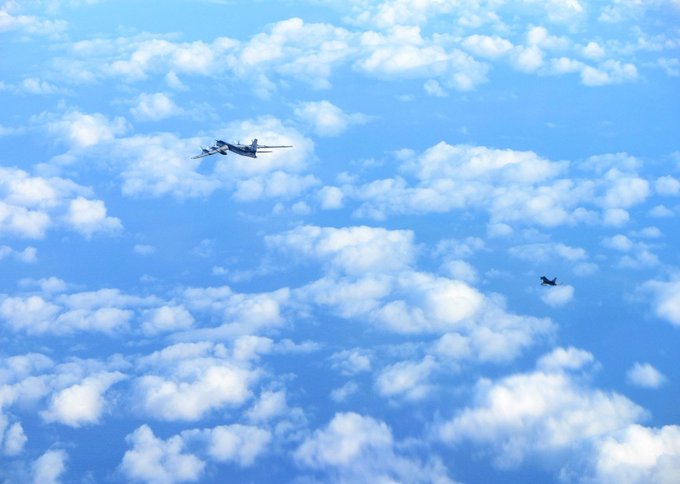
RAF Typhoons intercepted Russian Bear Aircraft
And the scariest part? This mobilization isn't patently unprovoked. Evidence has been leaked from security agencies discussing recent Russian air incursions, potentially military, strafing as far as eastern Poland. As such, these nations have "asked the Pentagon to send more troops to Eastern Europe to counter the perceived threat of Russia. There are currently 750 US soldiers in Poland and the Baltic states, but the organization believes that this is not enough."

“Because of the increased pressure that we feel in Eastern Europe now, and because of the assurance measures that we are taking in the Baltics, in Poland and in Romania, we require additional rotational presence,” Gen. Philip Breedlove, NATO’s supreme allied commander Europe, said at a Pentagon briefing Monday morning, which was reported by the US military website, Stripes.
AFP Photo/Paul J. Richards
NATO military aircraft dispatched on patrol

A major element of this operation is a test of the solidarity between the member nations of NATO in aid not just financial or small grade policing - the world seems to be the on the precipice of meltdown point Alpha, and that's when battles lines and true allegiances are unveiled.

The question is, where do those allegiances fall? 

"What is significant is that across history, most of these incursions have been very small groups of airplanes, sometimes singletons or at most two aircraft," NATO officer and spokesperson Breedlove, said. "What you saw this past week was a larger, more complex formation of aircraft carrying out a little deeper, and I would say a little bit more provocative, flight path."

Historical analysis seems an appropriate lens to view these events through, and so the comparisons and differences need to be illuminated as objectively as possible. Most of the Russian air operations before the most recent have been, at least in this humble observers opinion, reasonable and justifiable. However, the militaristic formations and arms on the most recent flocks of fighter jets is disconcerting, to say the least.

In a way that's far less positive than I would like it to be, it seems we will simply have to keep our eyes to the sky and hope that we're simply missing a piece of the puzzle.  

http://rt.com/news/202163-nato-pentagon-troops-europe/

Sunday, November 2, 2014

Racism in Russia

The spotlight on Russia's conflict with Ukraine has peaked the world's interest on life in Russia. There have been numerous reports of racism and sexism coming from not only the general population, but high-ranking politicians as well. For example, the star tennis twins, Venus and Serena Williams were called the "Williams Brothers" and nearly 200 attacks on African immigrants in Russia since 2010. The article below illustrates some stories of African immigrants in Russia and their struggle to adapt and find equality.


http://www.latimes.com/world/africa/la-fg-russia-africans-20141102-story.html#page=1