Showing posts with label David Houtson. Show all posts

Tuesday, October 27, 2015

Blini’s!

Blini are Russia's version of the thin French crêpe and a staple on most Moscovian menus, typically made with buckwheat for savoury fillings or white flour for sweet toppings. You'll see accompaniments of smoked salmon, creamy mushrooms, sour cream, jams and condensed milk– to name a few– but the high-end, revered combination is a spoonful of red salmon or black sturgeon caviar. Another tasty Russian pancake is the cottage cheese version called syrniki, a denser form of ricotta-pancakes, which are eaten for breakfast or dessert. They're best served with homemade jams made from Russia's large array of berries, although condensed milk, honey and sour cream are also served as condiments.(Expatica) 

Ingredients:
(makes ~15 crepes)

  • 2 eggs
  • 2 cups of milk (or heavy cream for more indulgent blini)
  • 1T sugar
  • 1/2t salt
  • approx. 2 cups of flour 
  • 2T canola or vegetable oil + more for rubbing the pan
Instructions:
  1. Whisk eggs, milk, sugar and salt
  2. Slowly start stirring in flour. Start with a cup, and stir a little more at a time until you get a runny batter but not as thin as milk - don't stress about this step, you can always adjust as you go!
  3. Stir in oil
  4. Let rest for 15 minutes
  5. Preheat a 10" pan over medium heat and rub with oil (I pour some in a little cup and dip a paper towel in, then run it around the pan before making each blin)
  6. Use a 1/4 cup or 1/3 cup measurer the scoop the batter into the middle of the pan, then quickly tilt the pan in a circular motion until the batter spreads to cover the pan surface. It should be a very thin layer*.
  7. Cook for 2-3 minutes on the first side, until small bubbles form on top and the crepe is light golden brown on the bottom. Flip and cook for 30 seconds. Repeat until batter is used (don't forget to rub the pan with oil each time!)
  8. As always, enjoy with sweetened condensed milk, sour cream and jam or any toppings, dips, or fillings of your choice. :)
*The first few blini may be experimental. Try the 1/4 cup and see if the batter covers the pan. Does it easily slide around the pan? If it's too thick, add some milk/cream to the batter. If it's too thin, add more flour to the batter. If it flows freely but doesn't properly cover the pan, use 1/3 cup per blin. I made these twice using a 10" pan, the first time 1/3 cup was perfect, the second time 1/4 cup was enough. Play with heat as well... my stove at home got hot quickly and the crepes were burning on medium (3.5/10 heat ended up perfect). At my parents' in law house in Maine, the pan wouldn't get hot enough on medium, but the crepes were cooking properly on medium high.
(http://www.russianbites.com)

Tuesday, October 6, 2015

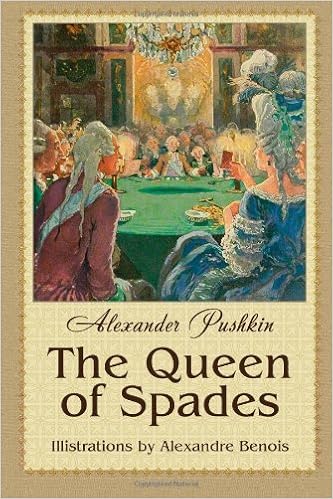
The Queen of Spades


Alexander Pushkin's "The Queen of Spades" is my one of my favorite Russian works of literature. Its about a Russian/German man that resisted the urge of gambling for his entire life, due to not wanting to lose too much. However, he soon learns of a secret, but sure way to win at gambling and does anything he has to do in order to get that secret. With a few surprises here and there, this short story kept me entertained all the way through, and had an amazing ending. It's also nice that it takes only forty-five minutes or so to read.

Tuesday, September 15, 2015

Tolstoy's "Family Happiness" *SPOILERS*

This blog contains spoilers so if you plan on reading this book turn back now.

My favorite part of all tolstoys works is that they can be interpreted in many different ways. Many see his works as terribly depressing, and others see them as uplifting. I am in the latter group,  and family happiness is on the examples that put me in that group.


Summery: This short story pries into the life of  Mashechka, a young woman in 1800's Russia. She believes that marriage is whimsical, romantic and full of love. She soon marries one of her fathers friends, Sergey, who had known her  since she was young.  Sergei was weary of the marriage because he believed that here youth would cause here to want to find adventure and excitement when he only wanted a happy and simple(aristocratic) lifestyle and especially detested the upperclass society of dances and city life. They lived on his estate in the country and had an easy and happy life. However, Mashechka wanted to go to St. petersburg and see the city. Wanting for her to learn of the horrbilness of the city life on her own, Sergey agreed and and they kept going back. However, she never does and keeps wanting to go back. Eventually they confront each other, but both are too full of pride to talk  it out. They eventually go back to his estate in the country and have a family. At one point Mashechka  full of despair, asks her husband why he does not have the same love and passion that he had for her when they first married. He explains that nothing has changed with his love for her, It is merely that they are not young anymore. While early in their marriage he loved her passionately, and their marriage was romantic, he  know loved her in a different way. She finally understood that she too did not want what they had in the past, but instead loved him as the father of her children and as an old friend. This gave her happiness that she had not had in a long time, and it stayed with her forever.

Many will believe that this is a depressing story about marriage that exemplifies how marriages can lose their passion and fall to pieces. However, I see this as a story that truly shows what it is like to grow old with one another, from the point of a passion filled new marriage to the days of a family where you see your spouse as an old friend who gives you happiness. "Family Happiness" is one of my all-time favorite's of Tolstoy's works.
The Saiga Antelope


http://www.rawstory.com/

Saiga antelopes used to have widespread populations throughout the northern hemisphere.  Today’s saiga antelope populations are mainly isolated to Kalmykia and Kazakhstan.

http://www.ultimateungulate.com/
 In May of 2015, the already endangered saiga antelopes faced huge die-offs, killing half of their populations in a few months. 

http://thewildlife.wbur.org/
This picture shows one heard that died off

The die-offs have now ended but the cause of the deaths is still unknown, many speculate that a bacterial disease was at fault.


Here's a link to a cute baby saiga antelope video

Thursday, September 18, 2014

The Rosselhoznador transit through Russia has banned poultry shipments from Germany and USA.  The employees of Rosselkhoznadzor banned transit through the territory of Russia with 375 tons of poultry meat from the United States.  Also, shipments have stopped of 420 tons of poultry from Germany into Uzbekistan.  According to the agency, in the veterinary certificates, Unites States lacked information on epizootic welfare exit-site production, as well as its safety and suitability of food.  Furthermore, production date does not match the information found in certificates.  As for the German meat, the physical inspection revealed that part of the boxes have the labels missing.  On the other part of boxes, it was applied in such a way that opening the packages will be impossible without compromising its ingtegrity.  In August, Russia decided on an embargo on the supply of food products from the United States, Canada, Australia, EU Member States and some other countries.  This decision was taken in response to the tightening of EU sanctions related to the Ukranian conflict.
 

Monday, February 4, 2013

Aleksandr (Sergeyevich) Pushkin (1799-1837)

The founder of Russian Literature. Born in Moscow, Russia. 
Aleksandr was born in a poor aristocratic family. His father descended from ancient noble family and his mother side, he was the great-great-grandson of a black slave named Abyssinian Dannibal who served under Peter the Great; which signified the fact that the slave brought over to Russia soon became a noble. In his childhood, his education was left to the nursemaids, french tutors and governess--this included the household serfs and his nanny Arina Rodionovna. At the age of 14, he submitted his first poem.

From there, he had written various literature styles--from poetry to verses/stories. Some stories and verses he has written were either translation from the nanny's fantasy story or they were stories detailing everyday lifestyles. This style was also found in his poems such as love, consciousness and politics (even though his friends could not consider him a political person).
For example: Я вас любил.../I loved you once...
Я вас любил: любовь еще, быть может
В душе моей угасла не совсем;
Но пусть она вас больше не тревожит;
Я не хочу печалить вас ничем.
Я вас любил безмолвно, безнадежно,
То робостью, то ревностью томим;
Я вас любил так искренно, так нежно,
Как дай вам бог любимой быть другим.
I loved you once: perhaps that love has yet
To die down thoroughly within my soul;
But let it not dismay you any longer;
I have no wish to cause you any sorrow.
I loved you wordlessly, without a hope,
By shyness tortured, or by jealousy.
I loved you with such tenderness and candor
And pray God grants you to be loved that way again.

This poem, as stated in the title is about a lost love or maybe a love he had once with someone--nevertheless, he only wishes that his once important person to be happy and loved by someone else.