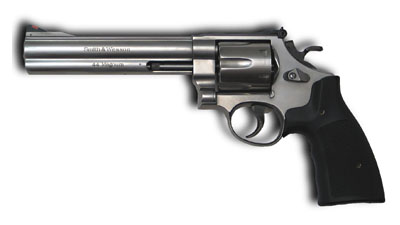
SO, I was wondering where Russian Roulette originated from since I've heard it's possibly not really Russian itself. This is what I found:
Most of the legends that abound regarding the invention of Russian roulette are, predictably, set in the Russian Empire or occur among Russian soldiers.
In one legend, 19th-century Russian prisoners were forced to play the game while the prison guards bet on the outcome. In another version, desperate and suicidal officers in the Russian army played the game to impress each other.
Whether Tsarist officers actually played Russian roulette is unclear. In a text on the Tsarist officer corps, John Bushnell, a Russian history expert at Northwestern University, cited two near-contemporary memoirs by Russian army veterans: The Duel (1905) by Aleksandr Kuprin and From Double Eagle to Red Flag (1921) by Pyotr Krasnov. Both books tell of officers' suicidal and outrageous behaviour, but Russian roulette is not mentioned in either text. The standard sidearm issued to Russian officers from 1895 to 1930 was the Nagant M1895 revolver. A double-action, seven chambered revolver, the Nagant's cylinder spins clockwise until the hammer is cocked. While the cylinder does not swing out as in modern hand-ejector style double action revolvers, it can be spun around to randomize the result. It is possible that Russian officers shot six and kept the seventh cartridge live. Due to the deeply seated rounds unique to the Nagant's cartridge and that the primers are concealed, it would be very difficult to tell from the outside where the live round was and which were spent; this would add to the uncertainty of the results.
Several teen deaths following the release of the film The Deer Hunter caused police and the media to blame the film's depiction of Russian roulette, saying that it inspired the youths.
-----
Thank you Wiki!
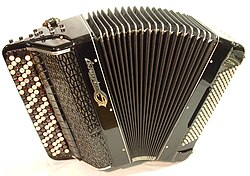 The Bayan is a chormatic button accordion developed in Russia in the early 20th century. It was named after the 11th-century bard Boyan. This instrument is different from regular keyboard accordions. Instead of a keyboard this instrument has a serious of chromatic buttons. The reeds in this instrument are broader and rectangular vs trapezoidal. This helps produce the fuller sound of the bass. The tone of the Bayan is best described as a miniature church organ. This instrument is usually only played by accordion virtuosi who want to perform classical music such as Bach.