Showing posts with label unit 9/10. Show all posts

Friday, May 8, 2009

Vladimir Voynovich

Vladimir Voynovich

I tried to post this earlier and the internet ate my post so here is the Encyclopedia Britannic biography of the writer whose style had a very strong contrast to Maxim Gorky [see my Unit 8 blog] besides some of the best modern Russian humor.

Russian author - in full Vladimir Nikolayevich Voynovich
born Sept. 26, 1932, Stalinabad, Tadzhik S.S.R., U.S.S.R. [now Dushanbe, Tajikistan]
Soviet dissident writer known for his irreverent and perceptive satire.
After serving in the Soviet army from 1951 to 1955 and attending the Moscow Pedagogical Institute (1957–59), Voynovich worked as a skilled labourer and then as an editor of radio programs.
He published such well-received fiction as the short story “My zdes zhivyom” (1961; “We Live Here” ) and the novellas Khochu byt chestnym (1963; “I Want to Be Honest”) and Dva tovarishcha (1964; “Two Comrades”), all of which concern pressures to conform to Soviet urban life.
In 1974, after publishing a letter in defense of dissident writer Aleksandr Solzhenitsyn, Voynovich was expelled from the Writers’ Union of the U.S.S.R. and was forbidden to work as a professional writer.
In 1980 he settled in West Germany. His Soviet citizenship was revoked in 1981 but was restored in 1990. In the 1980s he was a visiting writer at Princeton University and the University of Southern California.
Voynovich’s best-known work is the acclaimed underground novel Zhizn i neobychaynyye priklyucheniya soldata Ivana Chonkina (1975; The Life and Extraordinary Adventures of Private Ivan Chonkin), about a naive and unsophisticated man who battles the Soviet bureaucracy. The pseudoepic, autobiographical Ivankiada: ili rasskaz o vselenii pisatelya Voynovicha v novuyu kvartiru (1976; The Ivankiad: The Tale of the Writer Voynovich’s Installation in His New Apartment)details his personal battles with the Soviet bureaucracy to obtain a two-room apartment.
After he emigrated, he continued to write slyly humorous accounts of the vagaries of life under the Soviet system in works such as Pretendent na prestol: novye priklyucheniya soldata Ivana Chonkina (1979; Pretender to the Throne: The Further Adventures of Private Ivan Chonkin), Anti Sovetsky Sovetsky Soyuz (1985; The Anti-Soviet Soviet Union), Moskva 2042 (1987; Moscow 2042), and Shapka (1988; The Fur Hat). He also wrote film scripts and plays.
By the late 1960s, however, most of these writers had again been silenced. Solzhenitsyn—who was charged with treason shortly after the publication of the first volume of...
With the death of Stalin in 1953, Russian literature was freed from the most oppressive demands of socialist realism. The two decades after Nikita Khrushchev succeeded Stalin were characterized by a thaw, during which works were published that earlier would have meant prison or worse. Afterward, in the era of Leonid Brezhnev, there was again a hardening of official attitudes. One intriguing masterpiece, 'The Master and Margarita' by Mikhail Bulgakov, was published in the Brezhnev era. It had been written prior to 1940 but was not allowed publication until 1967.


In Dr. Huskey's first year seminar last semester we read The Life and Extraordinary Adventures of Private Ivan Chonkin and The Ivankiad: The Tale of the Writer Voynovich’s Installation in His New Apartment.
I really enjoyed the latter because it WAS autobiographical and provides a very sad yet realistic portrayal of life in the USSR (plus the constant image of the installation of a blue American toilet being behind Voynovich's rival’s quest for that extra room was just so very unexpected and Monty Python-esque I had to snort with laughter after I read that passage over ten times).

Wednesday, May 6, 2009

Disney always has a lesson for us!

After many many horrible hours of studying verbs of motion (sorry Denner, but it's true, they suck) I found a fun and silly way to see verbs of motion in action. Haha, I made a pun. Anyways... Here is A Whole New World in Russian, obviously, with subtitles so that when a verb of motion pops up, you can see how it translate. Enjoy!


Rasputin's Death

I'm not sure how many people read (or have even heard of for that matter) the website Cracked.com, but the authors there write some pretty hilarious articles. They ran this one article a few months back or so titled "7 Historical Figures Who Were Absurdly Hard To Kill." Not only did Rasputin take top place, but Trotsky was thrown in at number 4.

Here's a link to the article (WARNING! Explicit language....): http://www.cracked.com/article_16822_7-historical-figures-who-were-absurdly-hard-kill.html

And I feel the need to add some real merit to my post, so here is some information again on the death of Rasputin, in a much less interesting fashion: https://www.cs.tcd.ie/~peircen/xhtml/death_part_2.htm

Russian Mutants

Well since this is the last blog I figure I'd talk about Russian mutants. I mean why not?


So our first mutant is Colossus who actually stole his name from the Greek kolossus, "large statue." He had the superability to turn his skin into a hard organic metal and was one of the strongest of the X-men. Like all Russians, he has a quiet, shy character and is honest and innocent. Also like all Russians, he has lost his entire family, including his sister and his love interest. He also feels it is his responsibility to use his abilities for the betterment of human and mutant-kind like any reasonable Russian would. Basically Colossus epitomizes the good Russian (are there any other kinds) I mean, his name is Piotr Nikolaievitch Rasputin. How more Russian can you get?


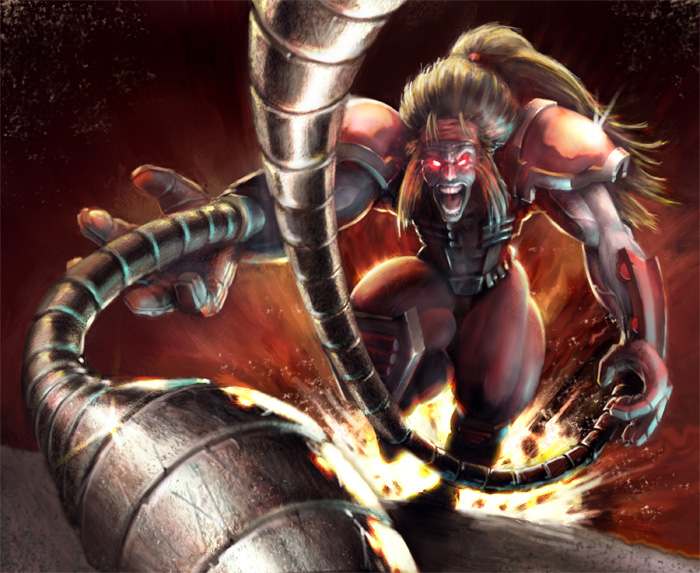
Our second mutant epitomizes the evil Russian. He's a murdering Russian raised in a small town of Siberia. That's right, it's Omega Red. Named Arkady Rossovich (another awesome Russian name) he killed people and then they tried to kill him but then discovered he was a mutant with superabilities and decided to make him a super soldier. Foolproof plan, eh? Well anyway, seems like he had regenerative abilities as well as the emission of death spores that killed people and stuff. The Russians in an arms race with the Americans made him to combat Captain America. So he's like Captain America only a serial killer, an agent of the KGB, and a crazy Russian. Like every evil Russian, he also is equipped with giant carbonadium whip-like tendrils that he can shoot out of his wrists. He uses his whips to mess people up. Also like all evil Russians, he is equipped with weird red armor and a funky hairstyle.

And that's it. Пожалуйста!

--Anders the Great.

Monday, May 4, 2009

End of the year reflection


Why did I decide to take Russian? I want to work in global market research at Goldman Sachs. I want to be a Russian spy for the CIA. It offers lots of scholarship opportunities. These are the answers I give when people ask me why I study Russian. Do you want to know the real reason I decided to take Russian? T.a.T.u., plain and simple, Я сошла с ума, All the Things She Said, got me where I am today. I remember the day we learned what the phrase сошла с ума meant, I thought to myself, "Mission accomplished." 

Needless to say, I've needed to do some re-evaluating my goals. Goal number 2: Memorize lots of russian poetry and collect some номер телефон. Speaking of телефон, that poem was not a good start. You can't even pretend that poem is suave, it rhymes like mother goose. 

Here is the video that got me interested in the mother tongue:


Here is the poem we were required to memorize for our final:


Not even close.

Next fall I am taking all Russian classes with the exception of Honors 3. Hopefully next Spring I will be abroad in the motherland. It seems like Russian pop has gotten me pretty far. 

Friday, April 17, 2009

Tetris (Unit 9/10)


One of the few games that gained ultimate popularity all over the world turns out to be a Russian invention. The ever so popular game of Tetris was created by Alexey Pazhitnov assited by Dmitry Pavlovsky and Vadim Gerasimov, Russian computer engineers in 1985. However, at the time the game was created intellectual property rights were not allowed for private individuals and the game was not patented.