This is Russian baritone Dmitri Hvorostovsky. He is without a doubt the most popular Russian opera singer alive today. His voice and his artistry are second to none. This is a clip of a young Dmitri singing in the Cardiff Singer of the World Competition. I bet you can tell why he won.
Tuesday, September 16, 2008

My first blog post!

I finally figured it out!
Anyway, I know the Olympics was a while ago, but there was one Russian guy in synchronized diving who really caught my attention that I'd like to share with you.
This smiling guy is the Men's Synchronised 3m Springboard silver medalist, Dmitry Sautin, and he owns at diving. He is the most decorated diver in history, with eight olympic medals and five Olympic Games under his belt.
What caught my attention was how out of place he seemed amongst the other divers. Sixteen years the senior of his synchronize diving partner, he looked markedly more crusty than the rest. And for good reason. Apparently he's had some pretty rough times: being nearly stabbed to death in a random act of violence in the early nineties, chronic back pain and broken bones, and a surgery mishap which involved a piece of bandage left in his back, fabric that accompanied him through the Sydney games and four olympic medals.
So here is this bent-looking Russian guy who looks like he just came from a bar and threw on a speedo, who then proceeds to do ridiculous things in the air before hitting the water, all at the same time as the guy next to him. It was refreshing to see someone who didn't look like he grew up on organic Wheaties and steroids do something amazing. It's a shame this was his last Olympics, but with injuries like his, who could blame him? I thought he was interesting, at least.
Cry me a what?
This is the most awsomeness thing EVER. This is a link to a Russian singer singing Cry Me A River (The Justin Timberlake song) in Russian...YES RUSSIAN.
http://www.youtube.com/watch?v=B3t2VyluTTQ
http://www.youtube.com/watch?v=B3t2VyluTTQ
Monday, September 15, 2008
Russian Ballet
 (Imperial School of Ballet)
Ballet in Russia began as a way to entertain the royal court. Then, in the 19th century, it was available to anyone who could afford a ticket. The first ballet company was the Imperial School of Ballet in St. Petersburg in the 1740s. Russian composers began writing special pieces to accompany the delicate art form. One of the first advocates was Sergei Diaghilev, who arranged the very first Paris tour of the Russian ballet. As it gained popularity, composer Igor Stravinsky and choreographer Fokin got involved to produce a famed program. As the years went on, ballet grew as an impressive art form that spread across Russia. Now the Moscow Ballet is a well known show that attracts visitors from around the world.


Love and marriage, Love and marriage...
Is there anymore more American than the sitcom? Frasier, Seinfeld, King of Queens, Everybody Loves Raymond, Married with Children...the list goes on and on and on and on and on. When one thinks of Russian television, one tends to think about the strictly supervised news programs of the Soviet era, and even today political satire is suppressed and news programs present only the Kremlin's point of view. However, in recent years, adaptations of American sitcoms have become among the most popular shows in
Here are clips from both the American and Russian versions of Married with Children. There definately seem to be similarities...Oh! They both have a dog!
THE ARTICLE
THE SHOW
THE ORIGINAL
Converse should have made history
History of Russian Costume, traditional dress
(And the part that converse shoes could have played)
 "The variety of colors for traditional costume displays love for beauty and ethnic diversity. These costumes are not only beautiful, there are also convenient in wearing because they were created for work as well." Likewise, converse shoes are used for both work and play. Not to mention the thousands of styles they come in.


 in our shoes:

(And the part that converse shoes could have played)
"Homemade canvas and wool clothes decorated with embroidery or woven pattern have been used most often for traditional peasant costumes." So canvas shoes would have fit right in.
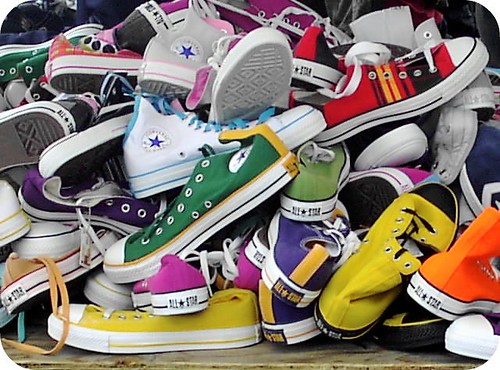 "The variety of colors for traditional costume displays love for beauty and ethnic diversity. These costumes are not only beautiful, there are also convenient in wearing because they were created for work as well." Likewise, converse shoes are used for both work and play. Not to mention the thousands of styles they come in.
 "Festive clothes and everyday clothes, married woman's and young girl's clothes differed only for details, decoration, and color gamut. Until the 17th century it was only outside trimmings that differed from nobles' costumes to the peasants' ones; general cut and style were all the same." Not only do kids these days wear converse for slumming around and for style, but even our modern-day nobles sport the canvas shoes. 


"Embroidery came in different ornaments (rhombuses, crosses, herring-bones, stylized patterns of people and animals) performed in naturally painted threads. Red, blue, green, white, yellow - the color gamut was rich and various." Not only do chucks come in so many different prints - you can specialize your own pair even - but they even still embroider them, too.

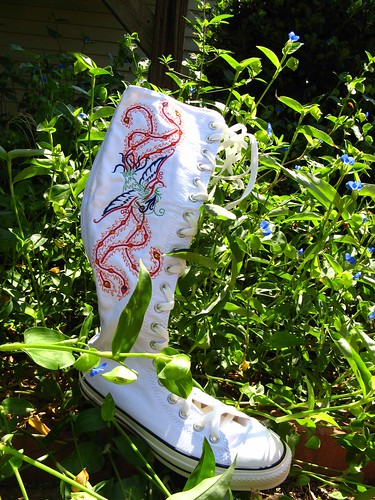
So after all that, just imagine these people:
in our shoes:And you'll realize that it probably makes a lot more sense than whatever they wore on their feet.
etymology
Etymology - the study of the history of words, including their origins and how their use has evolved alongside the languages that use them. A subject I've always been fascinated in, especially concerning the English language; as a global language used in numerous contexts by millions of people, English has evolved to include thousands of words from multiple languages. While the Russian influence on English is relatively small as compared to the Romance languages, there are some interesting things linking the two.
The word 'Russia' itself is derived from the old word Rus (from Arabic Rus, Greek Rhos); allegedly it originally referred to Scandinavian/viking traders who settled in the area around Kiev, and whose descendants supposedly controlled the region; the Finnish terms for Sweden and Russia are intricately connected, derived from the root of 'rowing' (as in a boat). The Finnish apparently thought the Swedes and Russians rowed a lot.
The word 'mammoth' is derived from a Russo-Finnish term meaning earth; mammoths were believed by excavators to have been burrowing creatures who rooted under the earth. The term then came to English from Russian.
The obvious connection between the months in most indo-european languages is interesting; in fact, like the English days of the week, the Indo-European months are derived from several sources, including numbers (october/октябрь, derived from 'octo' or 'eight'; the old Roman calendar had 10 months, October being the eighth), and a shared Indo-European mythology (or mythical references borrowed from Latin; I'm not sure where the Russian month names come from, but its possibly from Latin.) March and January come from Roman gods (Mars and Janus, respectably).
While historic language and the evolution of the Proto-Indo-European culture into the numerous cultures and languages it is today is incredibly fascinating, one could (and many have) fill entire books with interesting connections and observations.
The word 'Russia' itself is derived from the old word Rus (from Arabic Rus, Greek Rhos); allegedly it originally referred to Scandinavian/viking traders who settled in the area around Kiev, and whose descendants supposedly controlled the region; the Finnish terms for Sweden and Russia are intricately connected, derived from the root of 'rowing' (as in a boat). The Finnish apparently thought the Swedes and Russians rowed a lot.
The word 'mammoth' is derived from a Russo-Finnish term meaning earth; mammoths were believed by excavators to have been burrowing creatures who rooted under the earth. The term then came to English from Russian.
The obvious connection between the months in most indo-european languages is interesting; in fact, like the English days of the week, the Indo-European months are derived from several sources, including numbers (october/октябрь, derived from 'octo' or 'eight'; the old Roman calendar had 10 months, October being the eighth), and a shared Indo-European mythology (or mythical references borrowed from Latin; I'm not sure where the Russian month names come from, but its possibly from Latin.) March and January come from Roman gods (Mars and Janus, respectably).
While historic language and the evolution of the Proto-Indo-European culture into the numerous cultures and languages it is today is incredibly fascinating, one could (and many have) fill entire books with interesting connections and observations.
Tchaikovsky's Marche Slave
This piece was written by Pyotr Ilyich Tchaikovsky (1840-1893). As a prominent Russian and world composer, Tchaikovsky has given us some of the greatest works we know today, including: The Nutcracker Suite, 1812 Overture, and the Swan Lake ballet. Unlike these pieces though, Marche Slave is a far more ominous sounding orchestration, which is understandable considering it's history. Tchaikovsky wrote it for his friend, Nikolai Rubinstein who asked him to write a piece for the wounded Russian volunteers who were aiding the Serbians in the Serbo-Turkish war.
Russia Stock Market Fall Is Said to Imperil Oil Boom
Russia Stock Market Fall Is Said to Imperil Oil Boom.
One fallout of Russia's decision to respond disproportionately to Georgia's provocations in the Caucasus is the collapse of its stock market, in large part a response on the part of investors who now perceive a greater risk (higher risk premium), combined with the fact that the economy there is driven predominantly by commodity export (read: they export lots of fossil fuels), and commodity prices of been cliff-diving: Today crude dropped to $95... Earlier this summer, oil was close to $150 per barrel.
Russia Stock Market Fall Is Said to Imperil Oil Boom
The question, of course, is which is more important in the Russian market's slide? Is it politics driving the price of stocks down, or the decline in oil prices? The Times correspondent does a little research and finds...
One fallout of Russia's decision to respond disproportionately to Georgia's provocations in the Caucasus is the collapse of its stock market, in large part a response on the part of investors who now perceive a greater risk (higher risk premium), combined with the fact that the economy there is driven predominantly by commodity export (read: they export lots of fossil fuels), and commodity prices of been cliff-diving: Today crude dropped to $95... Earlier this summer, oil was close to $150 per barrel.
Russia Stock Market Fall Is Said to Imperil Oil Boom
MOSCOW — Rattled by falling oil prices and the war in Georgia, Russia’s stock market has slumped so severely that it now threatens the country’s oil-fueled boom of recent years, economists say.
The benchmark RTS index has lost 46 percent of its value since its peak in May, representing a paper loss of about $700 billion for Russian companies. Much of that decline has come since the war in Georgia and the subsequent war of words with the United States and Europe that unsettled foreign investors, who began withdrawing capital.
The question, of course, is which is more important in the Russian market's slide? Is it politics driving the price of stocks down, or the decline in oil prices? The Times correspondent does a little research and finds...
In one indication that Russian politics lubricated the market slide here, however, investors have pulled nearly $5 billion this year from emerging market funds with a heavy Russia weighting, according to EPFR Global, a company that tracks fund flows. By comparison, investments in Middle East and African funds, which are also seen as dependent on commodity prices, have risen this year.If that's the case, why the misleading headline? Shouldn't it read: "...Is Said to Imperil Free-Market Boom"?
Sunday, September 14, 2008
Tatu and Rammstein
Subscribe to:
Posts (Atom)