 Menacing, no?
Wednesday, December 19, 2007

Monday, December 10, 2007
Davis Cup Results
It appears that the winners on the court at this year's Russia versus U.S.A. was not the Russians. Davis Cup is the biggest team tennis event in professional tennis. It gives the players a chance to create a camaraderie with players from their country that they aren't able to have during traditional play. At the beginning of the Davis Cup final Russia has already lost the first two rubbers which gets the U.S. that much closer to the title. They only need one more point to win for the first time in 12 years. Dmitry Tursunov was first on court for the defending champions but was blown away by Andy Roddick in straight sets. Mikhail Youzhny then failed to play winning tennis against James Blake at the Memorial Coliseum. It was a much closer match with three of the sets going to tie-breaks. Blake however, edged out the Russian, three sets to one. That means the Bryan brothers will be the ones to watch to clinch victory for the hosts on Saturday when they play Davydenko and Andreev in the doubles.The tournament is still highly competitive but it's obvious that the singles loses for Russia is not going to be easy to forget.


Sunday, December 9, 2007
Russian Traffic Lights Unit 5
I thought this was funny! It's a traffic light in St. Petersburg.. watch closely most of the cars just keep going! I was reading an article on another blog and there are some really random traffic laws in Russia. For example, it's illegal for police to tow a man's car in the presence of that man.. does that make much sense???
ENJOY!
Saturday, December 8, 2007
"Russian Fashion Plays Green Card.."
In a world where social status can be can be judged by the clothes one wears or the car he or she drives, designer Alyona Akhmadulina strives to bring a new idea to such a materialistic culture. Akhmadulina is responsible for creating a special handbag that is environmentally friendly, and hopes that by doing so, people will realize that our environment is more important than overpriced, "high-fashion" accessories. The handbag itself is "made from 100% recycled cotton. It has no zippers, pockets or lipstick compartments. Instead, its makers believe it could help save the world. The money raised will go to WWF Russia to preserve plants, parks and forests". By wearing the handbag, you are not only helping the environment, but are helping to spread knowledge about the importance of eco-friendly products.
http://www.russiatoday.ru/entertainment/news/17968
http://www.russiatoday.ru/entertainment/news/17968
The AK-47
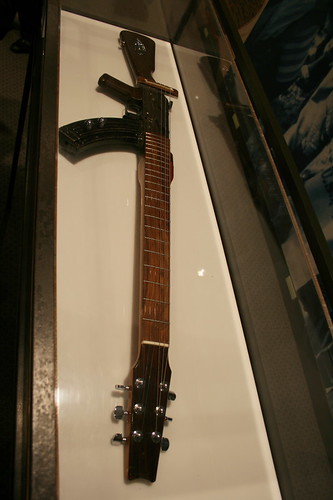
When you see a stereotypical terrorist or criminal, as depicted in movies, you almost always see them with AK-47s. Short for: "Автомат Калашникова образца 1947 года," this rifle has become the iconic weapon of rebels and guerrillas after World War 2. It is so widespread that the AK design was spread to over 55 national armies, and 100 million of the rifles have been produced so far.
The creator, Mikhail Kalashnikov, according to a BBC News article has expressed regrets over creating it:
"Mr Kalashnikov recently said he wished he had invented the lawn-mower instead.
He claims he has made no money from his rifle and is said to live on a meagre pension."
In 2006, Colombian musician and peace activist Cesar Lopez devised an AK converted into a guitar. One sold for US$17,000 in a fundraiser held to benefit the victims of anti-personnel, while another was exhibited at the United Nations.
I actually saw the one that you see above, which was set up in the UN building when I toured it last year.
Muslim Russians
Just come quick facts about Muslims/Islamic Russians
-Islam is the second biggest religion in Russia
-Most Islams are from Middle Volga and the Caucasus.
-they make up 15- 30% of the Russian population but is is hard to be completely accurate because there is no census in Russia
-it is projected that in the year 2050 half of Russia's population will be Islamic because of the immigration of Islamics from the Caucasus and central Asia.
hope you learned something today :-D
-Islam is the second biggest religion in Russia
-Most Islams are from Middle Volga and the Caucasus.
-they make up 15- 30% of the Russian population but is is hard to be completely accurate because there is no census in Russia
-it is projected that in the year 2050 half of Russia's population will be Islamic because of the immigration of Islamics from the Caucasus and central Asia.
hope you learned something today :-D
Helloa You Peoples. My Namea < Banned >
Some find Sacha Baron Cohen to be a offensive jerk, some think he's a comic genius the likes of which have rarely been seen. However, since Borat: Cultural Learnings of America for Make Benefit Glorious Nation of Kazakhstan is in fact a movie to be shown in private theaters, it is each persons choice whether or not to be subject to Cohen's blunt humor. Not in Russia it seems. The Russian government decided that because Borat "might seem disparaging in relation to certain ethnic groups and religions" and so it would not be shown in Russian theaters.
The Russian government has taken similar measures before, albeit with things that are public. For example, Russia prohibited a Gay Pride parade because some might be offended by the existence of gay people. They did the same for a group of racists from having their own march. When a small group of gay people got together to march anyway, they were savagely beaten by ultra-nationalists and then arrested.

The problem is the fact that everyone doesn't have to see Borat. Movies like The Da Vinci Code were allowed to play without controversy. But after the Danish Muhammad cartoon controversy, the Russian government became much more restrictive to things which could offend people's religious ideas. For the first time since the Soviets, a non-pornographic film was banned. This demonstrated the government's power to intervene in private affairs and it willingness to shut down people's freedom of expression of it conflicts with its interests. The interesting thing is that little uproar resulted from this ban, so the Russian government might be emboldened in any other assaults on private matters in the future.
The Russian government has taken similar measures before, albeit with things that are public. For example, Russia prohibited a Gay Pride parade because some might be offended by the existence of gay people. They did the same for a group of racists from having their own march. When a small group of gay people got together to march anyway, they were savagely beaten by ultra-nationalists and then arrested.

The problem is the fact that everyone doesn't have to see Borat. Movies like The Da Vinci Code were allowed to play without controversy. But after the Danish Muhammad cartoon controversy, the Russian government became much more restrictive to things which could offend people's religious ideas. For the first time since the Soviets, a non-pornographic film was banned. This demonstrated the government's power to intervene in private affairs and it willingness to shut down people's freedom of expression of it conflicts with its interests. The interesting thing is that little uproar resulted from this ban, so the Russian government might be emboldened in any other assaults on private matters in the future.
The Indo-Europeans, their culture, and Slavic Paganism
One of the most fascinating things about Europeans, to me, is their completely shared heritage and the intricate linguistic and cultural undercurrents that tie them all together. Today linguists, archaeologists and anthropologists hypothesize that most of the inhabitants of modern Europe (and the invaders who entered northern India; the situation there is a lot more complicated) are descended from a single group who spoke a single, unified language and practiced a single culture. Though it is disputed today where, exactly, this group of people resided, the most accepted model is the Kurgan Hypothesis, which places these 'Proto Indo-Europeans' as natives to an area north of the Caucasus, incorporating today the south-western region of Russia, eastern Ukraine and portions of Kazakhstan -
 The predominant evidence used by anthropologists to come to this conclusion is linguistic evidence - which, to those studying Indo-European languages (Russian is one), may seem obvious. The interconnectedness in vocabulary, grammar; shared verbs and idioms; each language family in Europe very obviously come from a strong, single parent language, with families and dialects differentiated in various ways (Grimm's Law for the Germanic languages and iotated vowels in Slavic languages, for example.)
Native religion is the other source of information about these proto-Indo-Europeans. Looking at the most famous forms of religion brought by Indo-Europeans into both Europe and India, the connections are startling, interesting and very strong. As is obvious, all fragmented Indo-European cultures practiced some form of polytheistic paganism, with many similar rituals and celebrations. The Greeks (and by extension the Romans), the Germanic peoples, Hinduism, and the ancient Slavic religion; all are descended from the same single cultural practice. While looking at some information about ancient Slavic paganism the connections became even more profound.
Unfortunately, for the information-hungry scholar, records of Slavic paganism are rare; there is no evidence of any kind of written language amongst the Slavic tribes before the introduction of Cyrillic and the conversion of much of eastern Europe to Christianity. As a result, one has to rely on the few mentions of ancient religion in modern customs, and in the historic documents of other nearby cultures (which are prone to bias; the Slavs were the last of the major inhabitants of Europe to convert - even the famously heathenistic Germans and Scandinavians wrote about how the Slavs were bloodthirsty pagans.) As a result the record is scant, but there are a few established facts.
Two of the key gods of the ancient Slavs were Perun, the sky god and Veles, the earth god. Perun is generally perceived to have been the supreme god of the Slavic pantheon; he is the most widely mentioned in the few sources that exist. Perun was the ruler of the sky and the god of lightning and storms; unlike many other religions, it is believed that the Slavs attributed many, many aspects of the world and their faith to each individual god (Veles is a better example; more on him later). Parallels can easily be drawn between Perun and various other Indo-European 'sky' or 'storm' deities; Perun's domain is shared by the Greek god Zeus (who also held a supreme position over the Greek pantheon); Perun can also be compared to the German Donar/Norse Thor, in that both are upright, valorous and mighty and control lightning, thunder and storms. The Hindu god Indra likely derived from the same proto-Indo-European belief as well; Indra controls the domains of weather. Perun's association with war also works out here; he was the patron of weapons and fighting, which works out with Thor's association with valor, strength and combat, and Indra's domain over warfare. Much of Slavic mythology appeared to revolve around the conflict between Perun and Veles. Unlike some of the other deities in Indo-European myth, Perun was treated rather mercifully by the Christians; his characteristics as the powerful lord of war and storms were absorbed by saints and other Christian figures after the Christianization of Russia.
Veles was one of the most broadly worshiped Slavic gods - he was associated with earth, the underworld and afterlife; the harvest, livestock, cows, dragons, poetry, magic and music. His portfolio seems to match that of the Germanic Odin, who also held domain over poetry, magic, music. Veles's worship was held sacred and separated from the worship of Perun and other similar deities; he was held as special for his strong association with the working people, the peasants, laborers and traders; and for his special domain over common life, as opposed to rulership of the heavens much associated with Perun. While the conflict between Veles and Perun, and its place alongside many traditions in Indo-European religion is too complex to recount completely (it's very interesting however; the battle between the sky god and snake is recurrent in many old pagan faiths), linguists and anthropologists believe that oral legends of the old Slavic religion often involved epic poetry about the battles of Perun and Veles. Like the Vedas of ancient Hinduism and the Eddas of the Norse pantheon, these poems celebrated bravery and the glory of battle.
There are other interesting bits about the old Slavic religion. Their cosmology is believed to bear a striking resemblance to the 'world tree' phenomenon present in other Indo-European faiths (a sacred oak is believed to have been the tree here; another reason that Veles was associated with oak trees, as he was located at the base of the world tree). Chernobog was believed to be a cursed or evil deity; however his occurrence seems unique only to western Slavs, and as a result he was likely not an old or important god. A number of deities or creatures originating from old folktales morphed into fairy tale characters, such as the old witch Baba Yaga. The topic is incredibly interesting to delve into, and if you're a dork like me you'll find all the interconnectedness of so many different cultures to be really intriguing.
 The predominant evidence used by anthropologists to come to this conclusion is linguistic evidence - which, to those studying Indo-European languages (Russian is one), may seem obvious. The interconnectedness in vocabulary, grammar; shared verbs and idioms; each language family in Europe very obviously come from a strong, single parent language, with families and dialects differentiated in various ways (Grimm's Law for the Germanic languages and iotated vowels in Slavic languages, for example.)
Native religion is the other source of information about these proto-Indo-Europeans. Looking at the most famous forms of religion brought by Indo-Europeans into both Europe and India, the connections are startling, interesting and very strong. As is obvious, all fragmented Indo-European cultures practiced some form of polytheistic paganism, with many similar rituals and celebrations. The Greeks (and by extension the Romans), the Germanic peoples, Hinduism, and the ancient Slavic religion; all are descended from the same single cultural practice. While looking at some information about ancient Slavic paganism the connections became even more profound.
Unfortunately, for the information-hungry scholar, records of Slavic paganism are rare; there is no evidence of any kind of written language amongst the Slavic tribes before the introduction of Cyrillic and the conversion of much of eastern Europe to Christianity. As a result, one has to rely on the few mentions of ancient religion in modern customs, and in the historic documents of other nearby cultures (which are prone to bias; the Slavs were the last of the major inhabitants of Europe to convert - even the famously heathenistic Germans and Scandinavians wrote about how the Slavs were bloodthirsty pagans.) As a result the record is scant, but there are a few established facts.
Two of the key gods of the ancient Slavs were Perun, the sky god and Veles, the earth god. Perun is generally perceived to have been the supreme god of the Slavic pantheon; he is the most widely mentioned in the few sources that exist. Perun was the ruler of the sky and the god of lightning and storms; unlike many other religions, it is believed that the Slavs attributed many, many aspects of the world and their faith to each individual god (Veles is a better example; more on him later). Parallels can easily be drawn between Perun and various other Indo-European 'sky' or 'storm' deities; Perun's domain is shared by the Greek god Zeus (who also held a supreme position over the Greek pantheon); Perun can also be compared to the German Donar/Norse Thor, in that both are upright, valorous and mighty and control lightning, thunder and storms. The Hindu god Indra likely derived from the same proto-Indo-European belief as well; Indra controls the domains of weather. Perun's association with war also works out here; he was the patron of weapons and fighting, which works out with Thor's association with valor, strength and combat, and Indra's domain over warfare. Much of Slavic mythology appeared to revolve around the conflict between Perun and Veles. Unlike some of the other deities in Indo-European myth, Perun was treated rather mercifully by the Christians; his characteristics as the powerful lord of war and storms were absorbed by saints and other Christian figures after the Christianization of Russia.
Veles was one of the most broadly worshiped Slavic gods - he was associated with earth, the underworld and afterlife; the harvest, livestock, cows, dragons, poetry, magic and music. His portfolio seems to match that of the Germanic Odin, who also held domain over poetry, magic, music. Veles's worship was held sacred and separated from the worship of Perun and other similar deities; he was held as special for his strong association with the working people, the peasants, laborers and traders; and for his special domain over common life, as opposed to rulership of the heavens much associated with Perun. While the conflict between Veles and Perun, and its place alongside many traditions in Indo-European religion is too complex to recount completely (it's very interesting however; the battle between the sky god and snake is recurrent in many old pagan faiths), linguists and anthropologists believe that oral legends of the old Slavic religion often involved epic poetry about the battles of Perun and Veles. Like the Vedas of ancient Hinduism and the Eddas of the Norse pantheon, these poems celebrated bravery and the glory of battle.
There are other interesting bits about the old Slavic religion. Their cosmology is believed to bear a striking resemblance to the 'world tree' phenomenon present in other Indo-European faiths (a sacred oak is believed to have been the tree here; another reason that Veles was associated with oak trees, as he was located at the base of the world tree). Chernobog was believed to be a cursed or evil deity; however his occurrence seems unique only to western Slavs, and as a result he was likely not an old or important god. A number of deities or creatures originating from old folktales morphed into fairy tale characters, such as the old witch Baba Yaga. The topic is incredibly interesting to delve into, and if you're a dork like me you'll find all the interconnectedness of so many different cultures to be really intriguing.
Friday, December 7, 2007
Russian Folk Instruments
балалайка - stringed instrument with 3 strings or 6 in pairs

The modern балалайка comes in six sizes - piccolo, prima, secunda, alto, bass, and contrabass.
The origins of this instrument are not precisely known, but the early representations resemble Central Asian instruments. The frets were tied to the neck and could be moved around the neck.
Fun Fact: The Beatles mention the балалайка on their White Album in the song "Back in the USSR".
Take me to your daddy’s farm
Let me hear your balalaikas ringing out
Come and keep your comrade warm.
I’m back in the USSR.
баян - a chromatic button accordion

This instrument was developed in the early 20th century and was named after the bard, Boyan.
The differences in construction from western accordions give the баян a different tone color; the bass has a much fuller sound.
Владимирский Рожок - a wooden horn with less than a two octave range and a very distinct sound

The repertoire for the folk music played on this instrument is divided into signal, song, dancing, and dance. A lot of folk music is played on this instrument because of the wide variety of shepherd's signals played on it.
The modern балалайка comes in six sizes - piccolo, prima, secunda, alto, bass, and contrabass.
The origins of this instrument are not precisely known, but the early representations resemble Central Asian instruments. The frets were tied to the neck and could be moved around the neck.
Fun Fact: The Beatles mention the балалайка on their White Album in the song "Back in the USSR".
Take me to your daddy’s farm
Let me hear your balalaikas ringing out
Come and keep your comrade warm.
I’m back in the USSR.
баян - a chromatic button accordion
This instrument was developed in the early 20th century and was named after the bard, Boyan.
The differences in construction from western accordions give the баян a different tone color; the bass has a much fuller sound.
Владимирский Рожок - a wooden horn with less than a two octave range and a very distinct sound
The repertoire for the folk music played on this instrument is divided into signal, song, dancing, and dance. A lot of folk music is played on this instrument because of the wide variety of shepherd's signals played on it.
I Googled it. So it must be true...
In recent years, the immigration of Chinese peoples into Russia has grown remarkably high. I researched this phenomenon and found that if this continues at the same rate, Russia will be home to 10 million ethnic Chinese. This will make the Chinese the second-leading ethnic group in the country, after Russians of course. One of the dilemmas Russia is facing because of this epidemic is that most of the Chinese immigrants in Russia tend to be unskilled workers or small time merchants. The Russian government is in debate on whether to develop an immigration point system (not unlike Canada’s*) to lure in a more skilled Chinese workforce. This is a pretty big deal considering both countries are in the middle of population crises that are polar opposites. Who knows, if this trend stays extreme both countries may even out!
Subscribe to:
Posts (Atom)