 The palace was first built around 1770 by the French architect Jean-Baptiste Vallin de la Mothe. Over the years numerous well-known architects worked on the palace, producing a variety of architectural styles. A. Mikhailov reconstructed the building during the 1830s when the Yusupovs became owners of the building. This was the period that the palace achieved its present-day appearance. From 1830 to 1917, the palace belonged to the House of Yusupov, an immensely wealthy family of Russian nobles, known for their philanthropy and art collections. Thus in the time of Imperial Russia, the palace became known as the Yusupov Palace. The luxurious interiors of the palace were not inferior to those of contemporary royal palaces. More than 40,000 works of art, including works by Rembrandt, jewelry, and sculptures decorated the palace. Following the Russian Revolution, the Yusupov art collections were nationalized and relocated in the Hermitage and other museums. Ernst Friedrich von Liphart, who was the curator of paintings at the Hermitage, had earlier painted the curtain and ceiling of the palace theatre. The palace is most famous, however, because of the actions of Prince Felix Yusupov, heir to the vast Yusupov family estates including four palaces in St. Petersburg. The palace on the Moika was the prince’s favorite residence in the capital. The exact events surrounding Rasputin's death are still in dispute. What seems clear is that on 30 December [O.S. 17 December] 1916, Felix Yusupov, along with Vladimir Purishkevich and Grand Duke Dmitri Pavlovich invited Grigori Rasputin to the Moika Palace. He took Rasputin to a small but lavishly furnished cellar room of the palace. There he served Rasputin red wine. When Rasputin was affected, Yusupov retrieved a revolver and shot Rasputin from the side. Taking him for dead, Yusupov went upstairs to where the other conspirators waited in a ground floor study/drawing room. Rasputin succeeded in fleeing through a side door into a gated courtyard which opened onto the street outside. Purishkevich then shot Rasputin in the back, on the doorstep. The body was taken inside and a third bullet, fired at close range, entered his forehead. The conspirators wrapped Rasputin in a broadcloth, drove outside the city and threw the body into the Malaya Neva.
Showing posts with label Unit 10. Show all posts
Showing posts with label Unit 10. Show all posts
Wednesday, May 4, 2016
Moika Palace
The palace was first built around 1770 by the French architect Jean-Baptiste Vallin de la Mothe. Over the years numerous well-known architects worked on the palace, producing a variety of architectural styles. A. Mikhailov reconstructed the building during the 1830s when the Yusupovs became owners of the building. This was the period that the palace achieved its present-day appearance. From 1830 to 1917, the palace belonged to the House of Yusupov, an immensely wealthy family of Russian nobles, known for their philanthropy and art collections. Thus in the time of Imperial Russia, the palace became known as the Yusupov Palace. The luxurious interiors of the palace were not inferior to those of contemporary royal palaces. More than 40,000 works of art, including works by Rembrandt, jewelry, and sculptures decorated the palace. Following the Russian Revolution, the Yusupov art collections were nationalized and relocated in the Hermitage and other museums. Ernst Friedrich von Liphart, who was the curator of paintings at the Hermitage, had earlier painted the curtain and ceiling of the palace theatre. The palace is most famous, however, because of the actions of Prince Felix Yusupov, heir to the vast Yusupov family estates including four palaces in St. Petersburg. The palace on the Moika was the prince’s favorite residence in the capital. The exact events surrounding Rasputin's death are still in dispute. What seems clear is that on 30 December [O.S. 17 December] 1916, Felix Yusupov, along with Vladimir Purishkevich and Grand Duke Dmitri Pavlovich invited Grigori Rasputin to the Moika Palace. He took Rasputin to a small but lavishly furnished cellar room of the palace. There he served Rasputin red wine. When Rasputin was affected, Yusupov retrieved a revolver and shot Rasputin from the side. Taking him for dead, Yusupov went upstairs to where the other conspirators waited in a ground floor study/drawing room. Rasputin succeeded in fleeing through a side door into a gated courtyard which opened onto the street outside. Purishkevich then shot Rasputin in the back, on the doorstep. The body was taken inside and a third bullet, fired at close range, entered his forehead. The conspirators wrapped Rasputin in a broadcloth, drove outside the city and threw the body into the Malaya Neva.
Monday, May 2, 2016
Igor Fyodorovich Stravinsky
И́горь Фёдорович Страви́нский
Igor Fyodorovich Stravinsky
Весна священная
The Rite of Spring
Ballet and orchestral
concert work by Stravinsky.
Written for the 1913
Paris season of Sergei Diaghilev’s Ballets Russes company.
The original choreography
was by Vaslav Nijinsky, with stage designs and costumes by Nicholas Roerich.
Stravinsky was a young, virtually unknown
composer when Diaghilev recruited him to create works for the Ballets Russes. The
Rite was the third such project, after the acclaimed Firebird
(1910) and Petrushka (1911). The concept behind The Rite of Spring,
developed by Roerich from Stravinsky's outline idea, is suggested by its
subtitle, "Pictures of Pagan Russia in Two Parts."
Stravinsky's score contains many novel
features for its time, including experiments in tonality,
metre,
rhythm, stress and dissonance. Analysts have noted in the score a significant
grounding in Russian folk music, a relationship Stravinsky tended to deny. The
music has influenced many of the 20th-century's leading composers, and is one
of the most recorded works in the classical repertoire.
The premiere was May 29, 1913

Дом Книги
Bookstores are my jam. There's just nothing quite like being surrounded by shelves full of pages of words. My affinity towards books and bookstores led me to look up Russia's most popular.

I came across the House of Books chain and found it interesting that though it was a chain, each individual store kept a flavor of its own. One of its stores is in St. Petersburg at the historic landsite of Дом компании «Зингер». This building used to be for the Singer Sewing Company and was constructed parallel to the company's headquarters being simultaneously built in New York. It is now home to many books and is referred to as such by the people.
Bookstores are awesome places and when housed in historic buildings like Дом компании «Зингер», they are all the better.

Bookstores are awesome places and when housed in historic buildings like Дом компании «Зингер», they are all the better.
The "Night Witches"

It was their enemies, the Nazis, who gave these women their nickname. Officially, they were the members of the Soviet Air Forces’ 588th Night Bomber Regiment. To the German pilots they fought, however, they were tormentors, harpies with seemingly supernatural powers of night vision and stealth. Shooting down one of their planes would automatically earn any German soldier the Iron Cross.
The legendary 588th was one of three all-female Soviet squadrons formed on Oct. 8, 1941, by order of Josef Stalin. The few hundred women who belonged to them — picked from thousands of volunteers — were the first of any modern military to carry out dedicated combat missions, rather than simply provide support.
The 80-odd Night Witches had arguably the toughest task of all. Flying entirely in the dark, and in plywood planes better suited to dusting crops than withstanding enemy fire, the pilots developed a technique of switching off their engine and gliding toward the target to enable them to drop their bombs in near-silence; they also flew in threes to take turns drawing enemy fire while one pilot released her charges. It was, quite frankly, awesome — as even their enemies had to admit. “We simply couldn’t grasp that the Soviet airmen that caused us the greatest trouble were in fact women,” one top German commander wrote in 1942. “These women feared nothing.”
Top Russian MP praises Trump’s pragmatism, readiness for cooperation
Recently, The head of the State Duma Committee for Foreign Relations said that Donald Trump's approach to politics makes him a better presidential candidate then any other in the current race. He states that his approach is different from Obama and Bushes fixation on "spreading liberal ideology and values"

The MP stated, "Overall, Trump looks less ideologically biased than [the incumbent US President Barack] Obama. He is a businessman who sees everything as a string of business deals. This is not the worst of approaches, especially if compared to the purely ideological, fundamentalist approach of Bush’s and Obama’s administrations. They destroyed the lives of whole regions and peoples in the name of some liberal chimeras and pseudo values,”
The head MP also criticized Clinton on her support of military interventions. "Clinton bases her actions on the suggestion that everything depends on the United States’ will. But she is mistaken. The Syrian crisis has shown that regardless of US desire to displace Syrian President Bashar Assad, Assad is likely to remain in his post after Obama leaves his,” Pushkov told the newspaper."
Sunday, May 1, 2016
10 things to never say or do in Russia!
I know many people who plan to study abroad in Russia and figured this will help. Here are some rules.
1. Don't come to a visit empty handed
A sign of respect is to bring a present
2. Don't leave your shoes on in someones home.
Russian homes often have nice rugs therefore outside shoes are not welcome. some even bring nice shoes to parties to change into
3.DO NOT joke about parents
Vulgar jokes are normal, but jokes about parents they will not get or be offended
4.Don't toast with "Na Zdorov'ye!"
This means in good health, but for a toast longer more extravagant speaches are expected.
5.Don't take the last shirt
Now this is a saying. When you are offered something refuse the first few timesexpecially if you are to leave soon. If they keep persisting then say yes.
6.Don't under dress
You only live once, dress nice and feel nice. Its normal to dressup for casual things.
7.Don't go dutch
Men are to pay for food when out or whoever invited you to the food occasion is expected to pay.
8.Don't let a woman carry something heavy
Don't cringe! Men are said to be physically stronger and should carry things if they see a woman carrying something heavy.
9.Don't overlook the elderly on public transportation
If you see an elderly person, offer them your seat.
10.Don't burp in public
Bodily functions are considered impolite in Russia.
Good Luck
1. Don't come to a visit empty handed
A sign of respect is to bring a present
2. Don't leave your shoes on in someones home.
Russian homes often have nice rugs therefore outside shoes are not welcome. some even bring nice shoes to parties to change into
3.DO NOT joke about parents
Vulgar jokes are normal, but jokes about parents they will not get or be offended
4.Don't toast with "Na Zdorov'ye!"
This means in good health, but for a toast longer more extravagant speaches are expected.
5.Don't take the last shirt
Now this is a saying. When you are offered something refuse the first few timesexpecially if you are to leave soon. If they keep persisting then say yes.
6.Don't under dress
You only live once, dress nice and feel nice. Its normal to dressup for casual things.
7.Don't go dutch
Men are to pay for food when out or whoever invited you to the food occasion is expected to pay.
8.Don't let a woman carry something heavy
Don't cringe! Men are said to be physically stronger and should carry things if they see a woman carrying something heavy.
9.Don't overlook the elderly on public transportation
If you see an elderly person, offer them your seat.
10.Don't burp in public
Bodily functions are considered impolite in Russia.
Good Luck
Saturday, April 30, 2016
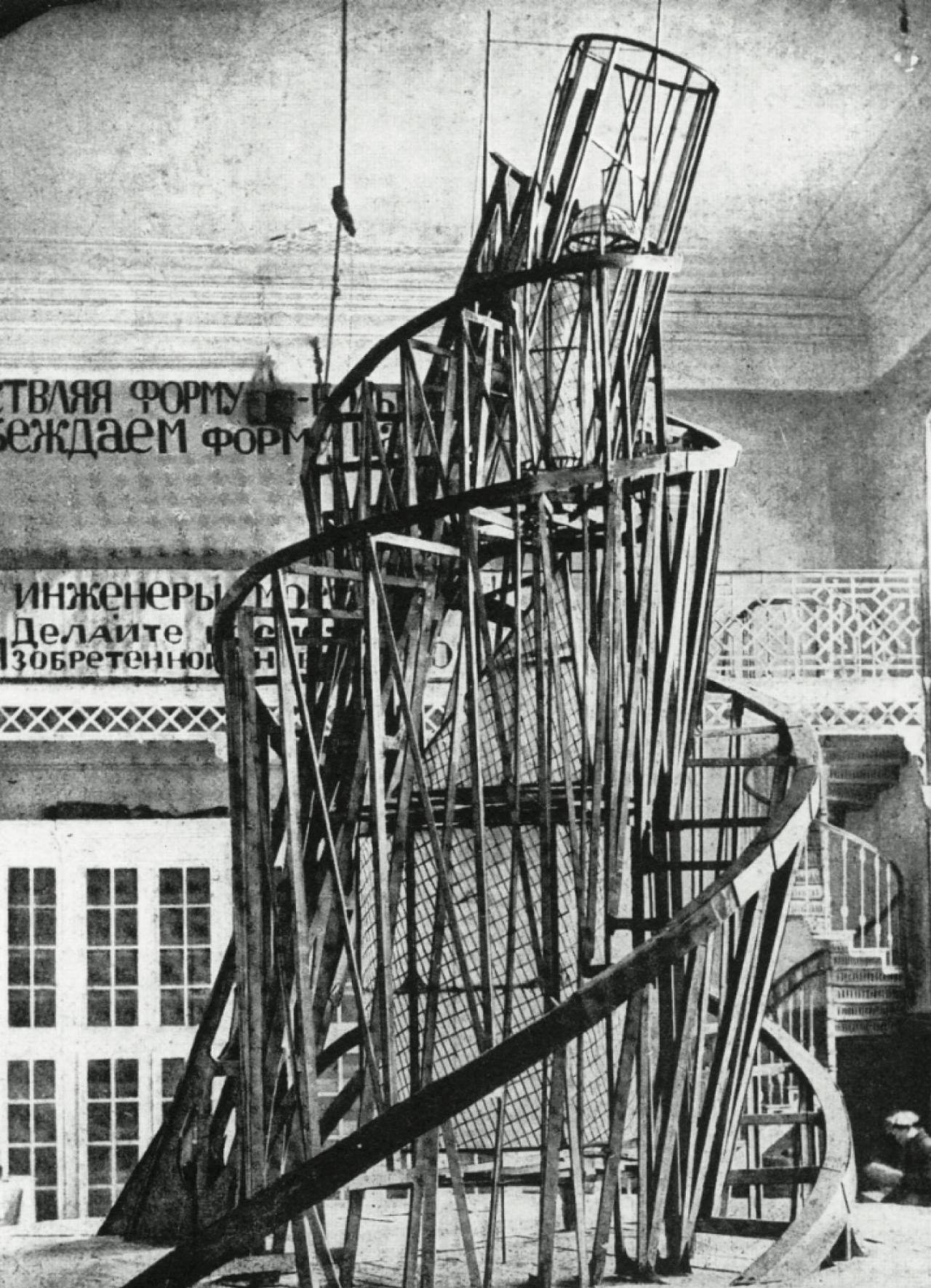
Tatlin's Tower
Vladimir Tatlin designed Tatlin's Tower also known as the monument to the Third International to be built in present day St. Petersburg after the Russian revolution in 1917. The building was going to be purposed for the comintern, who's purpose was the spread of communism on a global scale and would be a news outlet for the country. While never built the building had very ambitious plans. It was going to rotate at three different speeds. One part would rotate daily, another monthly, and another yearly. The building was intended to show the strength and ambition of the newly formed Soviet union. It is considered part of the constructivist movement in Russia.
As an American I find it strange that it is ingrained in Russian culture to not smile. So in order to better understand why and how I did some research. Below is what I found out.
The closed-mouth smile: Most often, Russians smile only with their lips, only occasionally showing the upper row of teeth slightly. Revealing the top and bottom teeth is considered vulgar, as it resembles that of a horse.
The servants smile: In Russian communication, a smile is not a signal of politeness. Russians consider a perpetual polite smile an “servant’s smile.” It is considered a demonstration of insincerity, secretiveness and unwillingness to show one’s true feelings.
The non-smile: In Russian communication, it is not acceptable to smile at strangers. Russians smile mainly at people they know. This is why salespeople do not smile at shoppers.
The responsive smile: Russians do not automatically respond to a smile with a smile. If an acquaintance responds to a smile with a smile, this is considered an invitation to come over and start a conversation.
The smile as a symbol of affection: A Russian smile demonstrates to the recipient that the smiling person has personal affection towards him or her. A smile directed at a stranger may elicit the reaction, “Do we know each other?”
The official’s non-smile: Among Russians it is not acceptable to smile while performing one’s job or any important business. Customs agents do not smile because they are occupied with serious business. This is the same for salespeople and wait staff. It is not acceptable for children to smile in class. One of the most common remarks Russian teachers make is, “What are you smiling at? Write!.”
The genuine smile: In the Russian collective consciousness, there is a rule: the smile must be a genuine reflection of a good mood and good relationship. In order to have the right to smile, one must truly like the person in question or be in a very good mood at the moment.
The smile with no reason: If a Russian person smiles, there should be a good reason behind it – and everyone should know this reason. If the reason for a smile is not clear, Russians may worry about the reason behind it.
The appropriate smile: The other people present must consider the smile to be appropriate for the context. It is not acceptable to smile in a difficult situation or if there are people around with known serious troubles, or if someone is ill or preoccupied with personal problems and so on.
A laugh as a smile: Among Russians there is a blurred line between a smile and laughter; in practice, these phenomena are often the same and are likened to each other. Russians often say to people who are smiling, “What’s so funny?”
Source:http://www.wikihow.com/Understand-a-Russian-Smile
The closed-mouth smile: Most often, Russians smile only with their lips, only occasionally showing the upper row of teeth slightly. Revealing the top and bottom teeth is considered vulgar, as it resembles that of a horse.
The servants smile: In Russian communication, a smile is not a signal of politeness. Russians consider a perpetual polite smile an “servant’s smile.” It is considered a demonstration of insincerity, secretiveness and unwillingness to show one’s true feelings.
The non-smile: In Russian communication, it is not acceptable to smile at strangers. Russians smile mainly at people they know. This is why salespeople do not smile at shoppers.
The responsive smile: Russians do not automatically respond to a smile with a smile. If an acquaintance responds to a smile with a smile, this is considered an invitation to come over and start a conversation.
The smile as a symbol of affection: A Russian smile demonstrates to the recipient that the smiling person has personal affection towards him or her. A smile directed at a stranger may elicit the reaction, “Do we know each other?”
The official’s non-smile: Among Russians it is not acceptable to smile while performing one’s job or any important business. Customs agents do not smile because they are occupied with serious business. This is the same for salespeople and wait staff. It is not acceptable for children to smile in class. One of the most common remarks Russian teachers make is, “What are you smiling at? Write!.”
The genuine smile: In the Russian collective consciousness, there is a rule: the smile must be a genuine reflection of a good mood and good relationship. In order to have the right to smile, one must truly like the person in question or be in a very good mood at the moment.
The smile with no reason: If a Russian person smiles, there should be a good reason behind it – and everyone should know this reason. If the reason for a smile is not clear, Russians may worry about the reason behind it.
The appropriate smile: The other people present must consider the smile to be appropriate for the context. It is not acceptable to smile in a difficult situation or if there are people around with known serious troubles, or if someone is ill or preoccupied with personal problems and so on.
A laugh as a smile: Among Russians there is a blurred line between a smile and laughter; in practice, these phenomena are often the same and are likened to each other. Russians often say to people who are smiling, “What’s so funny?”
Source:http://www.wikihow.com/Understand-a-Russian-Smile

Thursday, April 28, 2016
Ключевская сопка
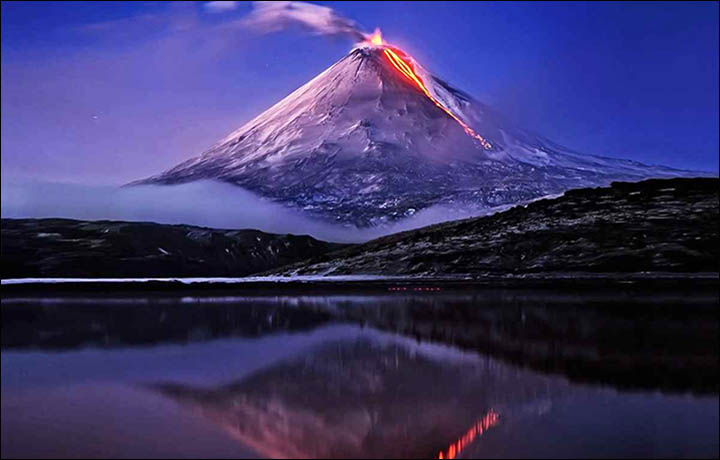
Russia is also home to the world’s largest active volcano Klyuchevskaya Sopka, which has a height of 4,750 m (15,584 ft). It is cone shaped volcano, that can be climbed from all sides. Mostly, climbs are from the pass between Klyuchevskaja nad Kamen from the south. Less popular is west route. The height of Klyuchevskaja is in the range from 4750 to 4850 m according to different sources. However, on the north side of the summit crater it is 4750 m.During the summer a helmet is necessity due to the falling of stones and rocks. In summer 2003, one Czech turist was hit to death by stone on the slope of Klyuchevskaja, and several members of rescue team were injured. For winter and spring climbs you need crampoons, ice-axe, avalanche transceiver, snow showel, etc. Helmet is recommendable, but not necessary, as majority of stones and rocks area stabilizated by ice and snow.
Difficulties of the climb are mostly near the summit - strong volcanic activity, gases, temperature, etc. During the climb the worst troubles are falling stones and rocks. We set up our camp on the north at the altitude 2070 m, so that, 2700 altitude meters were for summit day. Usually, the advance camp is set up from the north/north-west at 2700-2900 m. From the south the summit day starts from the pass between Klyuchevskaja and Kamen.

Thursday, April 14, 2016
Russian National Parks
So when I first began to research this topic, my hypothesis
was that I would not find any national parks in Russia. Some of what we’ve
studied would support this theory. Russia does not have a brilliant track
record for environmental care, with disasters like the Chernobyl of the Soviet
Union still fresh in our minds, it may come as a surprise to note that Russia
has not only national parks, but the best protected parks in the world. Check
it out.
Few people realize that Russia has one of the world's
premier systems of protected areas, which preserves millions of acres of wild
landscapes - important habitat for a vast number of plants and animals. Wild
Russia is an international effort to document images of the wild nature
harbored in Russia's system of strict nature reserves and national parks.
Through the Wild Russia project, we aim to promote worldwide appreciation for
Russia's vast network of protected areas and to increase understanding of the
opportunities these areas offer for conserving the planet's biodiversity.
Many of Russia's wild lands form part of a network of
strictly protected scientific nature reserves called Zapovedniks
(Zap-o-VED-nik), the highest category of nature conservation in the world (IUCN
category I). The first Zapovednik, Barguzinsky, was created in 1916 on the
eastern shore of Lake Baikal. Now, 101 Zapovedniks, covering more than 33.5
million hectares (82.7 million acres), protect diverse wilderness areas across
the country. From the tundra in the far north to the steppe (prairies) in the
south, from the Black Sea to the Bering Sea, these Zapovedniks cover a
tremendous diversity of territory and play a critical role in nature
conservation.
Check the link!
http://www.wild-russia.org/
Tuesday, May 5, 2015
The Tale of Ivan Tsarevich, the Firebird, and the Gray Wolf
While reading last night, I read that firebirds are legendary Russian creatures that send heroes on quests and adventures. I thought that that was an interesting and looked into the birds more. I stumbled on this tale of Ivan Tsarevich, the Firebird, and the Gray Wolf.
 Once upon a time in a far away land, there lived a mighty tsar. The pride of the tsar's kingdom was a magnificent orchard, second to none. However every night a firebird, with golden feathers and eyes like crystal, would swoop down on the tsar's favorite apple tree, and fly off with a few golden apples. The tsar was very distressed at this and called in his three sons to help."My dear sons," he said, "to whichever one of you is able to catch this firebird and bring it back alive, I will give half of my kingdom now, and the other half when I die."
The three sons promised to do their best to catch the bird. The oldest son stood watch the first night, but he fell asleep and the firebird made off with a number of apples. The next night, the second oldest son camped out by the apple tree in hope of catching the bird but he, too, fell asleep, and the firebird stole a few more apples.
The third night the youngest son, Ivan Tsarevich, guarded the tree. One hour went by, then a second, and a third ... Ivan was sleepy but took his job seriously and managed to stay awake. Suddenly the whole orchard lit up, as if a thousand lights were shining on it - the firebird was making its entrance! As the bird began to pluck golden apples off the tree one-by-one, Ivan sneaked up and grabbed it by the tail. But the bird managed to wriggle out of Ivan's grasp, leaving the youth with only a bright red tail feather. The feather was so luminescent that if it were brought into a dark room, the room would glow, as if illuminated by the setting sun.
The firebird never came back to the orchard after this, but the tsar was so enchanted by the glowing feather that he sent his sons out again to find the bird and bring it back alive. The two older sons, filled with envy that their younger brother was able to bring back a feather from the bird, went off together on their search. Ivan left on his horse alone.
Ivan rode on and on until he reached a big stone standing in the middle of an open field. On the stone were the following words: "He who goes straight will be hungry and cold. He who passes to the right will be safe, but his horse shall die. He who passes to the left will be killed, but his horse will be safe." Choosing the lesser of three evils, Ivan decided to go to the right and rode for three days.
Suddenly a gray wolf appeared out of nowhere and devoured the horse. For a long time, Ivan wept and eventually continued his journey on foot. He walked for an entire day and became very tired. The gray wolf suddenly appeared again. "I'm sorry I killed your horse," the wolf said, "and making you go all this way on foot. But it was God's will. Jump on my back, though, and I'll take you where you want to go!" Ivan, for some reason, began to trust the wolf now and told the animal that he needed to find the firebird. He climbed on the wolf's back and they sped off like a flash.
After a short while, they reached a stone wall. "Climb over that wall, Ivan, and you will find the firebird sitting in a golden cage in a garden. Take the bird, but don't touch the cage or you will be caught."
Ivan did as the wolf instructed and had the bird in his hand, when he thought, Where am I going to put the bird if I don't take its cage? So he went back to get the golden cage and the minute he touched it, alarms went off and guards seized the lad. He was immediately taken to the tsar, who was furious and demanded an explanation. "I'm the son of Tsar Vislav" Ivan said, "and the firebird had been taking apples from my father's orchard every night. So he sent me to get the bird."
"Well, if you had just come and asked me, I would have given the bird to you," the tsar said. "But now you have disgraced yourself by thievery. However, there is something that you can do for me to redeem yourself. Go to the kingdom of Tsar Afron and bring back the horse with the golden mane. If you do this, I will forgive you and you can have the firebird."
Ivan left the tsar and told the wolf everything that had happened. He said he was very sorry that he had not listened to the wolf about not touching the golden cage.
"Well, what's done is done. Get up on my back and I will take you where you need to go," the wolf said.
Ivan got up on his back and the wolf took off like a bullet. It was hard to say whether it was a long time or a short time, but eventually they reached the kingdom of Tsar Afron. When they stood before the royal stables, the wolf told Ivan to take the horse with the golden mane, but not to touch the golden bridle hanging on the wall. Ivan went in and started leading the horse out. Then all of a sudden he saw the magnificent golden bridle. He was so attracted to it that he simply could not resist taking it. But the second he touched it, alarms went off and stable boys came running to seize the young man. They took him to Tsar Afron, who was furious and demanded an explanation. Ivan told him the whole story.
"Well, if you had just come and asked me, I would have given the horse to you! But now how will it look when I tell the whole kingdom what you've done? However, to get your honor back, there is something that you can do for me. Go to the Thrice Tenth Kingdom and bring back the princess Elena the Fair. I want her, but I have not found a way to get her here. If you do this, I will pardon you and will give you the golden bridle."
Ivan left the palace in tears and told the gray wolf everything. He apologized for again disobeying the wolf's instructions.
"Well, what's done is done. Get on my back and I'll take you where you need to go," the wolf said. Ivan jumped on the wolf's back and off they went.
When they reached Elena's kingdom, the wolf told Ivan to wait by a green oak tree. This time the wolf was going to do the job himself! When the princess was walking in her garden, the wolf grabbed her and they hurried back to the tree, where Ivan was waiting. Ivan climbed onto the wolf's back next to the beautiful princess and they headed back to the kingdom of Tsar Afron.
As fate would have it, Ivan and the princess fell in love on the wolf's back. Approaching the kingdom, Ivan was in tears. "My dear friend, the wolf, how can I not grieve? Elena and I are in love and now I have to return her to Tsar Afron, or else I will be held in disrepute throughout the kingdom."
"I have served you well," the wolf answered, "and I will help you again. This is what I will do: I will transform myself into the princess and you can take me to the tsar. He will think that I am Elena. Then, when you are riding back in the open field on the horse with the golden mane, and when I am allowed to go outside to walk with my ladies-in-waiting, think of me and I will appear."
Ivan liked the idea and, like magic, the wolf turned into the princess! Ivan led him to the tsar, who was overjoyed at seeing who he thought was the princess. Ivan was immediately given the horse with the golden mane and rode toward the kingdom of Dolmat (secretly picking up the real princess where he had left her). For several days, the two were so enchanted with each other that they completely forgot about the gray wolf. Then, on the fourth day, Ivan thought "What happened to my friend, the wolf?" It just so happened that this was the first day that the wolf was permitted to leave the tsar's palace so he could escape. And just as thoughts about the wolf entered Ivan's head, the wolf appeared there!
So Ivan, the princess, the wolf and the golden-maned horse began their journey to the kingdom of Dolmat. When they approached its border, Ivan said to the wolf, "Listen, my dear friend, you have done much for me, but could you do one more thing? I would love to have this golden-maned horse to bring back to my own kingdom. Could you turn yourself into a horse, and we'll do the same thing we did with the last tsar?"
Poof! The wolf turned into a golden-maned horse. Ivan presented him to the tsar, who was quite jubilant and they all sat down for a large feast which lasted two full days! On the third day, the tsar gave the firebird to Ivan. Ivan then left for the trip back home, picking up Elena and the real golden-maned horse along the way. It wasn't long before the tsar went out riding with his new horse (who, of course, was really the wolf). At an opportune time, the tsar was thrown off his mount and all he saw after that was tail end of the wolf running off into the distance!
With his speed, it didn't take the wolf long to catch up with Ivan and Elena the Fair. They traveled together until they reached the place where the wolf had eaten Ivan's first horse. "Now it's time to part," the wolf said. "You have a horse again and I can't be of any more service to you." The wolf ran off and Ivan shed many tears over the parting of his good friend and companion.
Ivan, the princess, the firebird and golden-maned horse headed home. They were still many miles away from the kingdom when they stopped to rest. They tied the horse to a tree and kept the bird beside them. If you remember, the tsar's two older sons, Dmitriy and Vasiliy, had also been looking for the firebird. They were returning to the kingdom themselves when they stumbled upon the sleeping Ivan and Elena. They were quite charmed by the golden-maned horse, the firebird, and Elena. Filled with envy, they decided to kill their brother. Dmitriy took out his sword and thrust it into the body of Ivan. Then they woke Elena, who saw the motionless body of her sweetheart and burst into tears. "You might have been called honorable knights if you fought and won a battle in an open field. But as it is, you killed someone who was sleeping and defenseless. What kind of respect could you possibly deserve?"
The brothers paid no attention and rode back to their kingdom with their treasures, including the lovely Elena. "One word of this to the tsar," they warned, "and you won't live to see another day!"
The slain Ivan lay for exactly thirty days on the spot where his brothers had left him. Then the gray wolf found him, recognizing the lad by his scent. He wanted to help his friend, but he didn't know what to do. When he saw a mother crow and her two babies circling and hungrily looking at Ivan, he waited until they landed and grabbed one of the babies.
"Please don't harm my child," the crow pleaded. "He's done nothing to you."
"Then go to the Thrice Tenth Kingdom and bring me back some magical life-and-death water. Your child will be safe if you do this," the wolf said. The crow agreed and flew off.
On the third day, the mother crow returned and brought two vials of water. Without warning, the wolf ripped into the flesh of the young crow he was holding, and tore it in two. Then he sprinkled some "water of death" on the young crow and the crow's wounds were healed. Next he sprinkled some "water of life" on him, and the young crow came to life, fluttered his wings, and flew off to his nest!
The wolf repeated the procedure with Ivan. Miraculously, the boy came to life, saying, "Oh, how long I've slept!" "Yes," the wolf said, "and you would have slept much longer had I not found you!" He told Ivan everything that had happened and that today Ivan's brother Vasiliy was about to marry Elena the Fair. The wolf told Ivan to climb on and in a flash they were off for the city.
Ivan arrived as the wedding feast was already in progress. Elena saw Ivan and jumped up from the table. "There is my dear fiance, not this coward sitting next to me!"
The tsar, confused at this turn of events, asked for an explanation and Elena gladly told him everything. The tsar, quite naturally, was furious with the brothers Dmitriy and Vasiliy and threw them in prison.
Ivan and Elena got married themselves and were so happy with each other that they never parted.
Source: http://stpetersburg-guide.com/folk/swolf.shtml
The Tale of Ivan Tsarevich, the Firebird, and the Gray Wolf
Once upon a time in a far away land, there lived a mighty tsar. The pride of the tsar's kingdom was a magnificent orchard, second to none. However every night a firebird, with golden feathers and eyes like crystal, would swoop down on the tsar's favorite apple tree, and fly off with a few golden apples. The tsar was very distressed at this and called in his three sons to help."My dear sons," he said, "to whichever one of you is able to catch this firebird and bring it back alive, I will give half of my kingdom now, and the other half when I die."The three sons promised to do their best to catch the bird. The oldest son stood watch the first night, but he fell asleep and the firebird made off with a number of apples. The next night, the second oldest son camped out by the apple tree in hope of catching the bird but he, too, fell asleep, and the firebird stole a few more apples.
The third night the youngest son, Ivan Tsarevich, guarded the tree. One hour went by, then a second, and a third ... Ivan was sleepy but took his job seriously and managed to stay awake. Suddenly the whole orchard lit up, as if a thousand lights were shining on it - the firebird was making its entrance! As the bird began to pluck golden apples off the tree one-by-one, Ivan sneaked up and grabbed it by the tail. But the bird managed to wriggle out of Ivan's grasp, leaving the youth with only a bright red tail feather. The feather was so luminescent that if it were brought into a dark room, the room would glow, as if illuminated by the setting sun.
The firebird never came back to the orchard after this, but the tsar was so enchanted by the glowing feather that he sent his sons out again to find the bird and bring it back alive. The two older sons, filled with envy that their younger brother was able to bring back a feather from the bird, went off together on their search. Ivan left on his horse alone.
Ivan rode on and on until he reached a big stone standing in the middle of an open field. On the stone were the following words: "He who goes straight will be hungry and cold. He who passes to the right will be safe, but his horse shall die. He who passes to the left will be killed, but his horse will be safe." Choosing the lesser of three evils, Ivan decided to go to the right and rode for three days.
Suddenly a gray wolf appeared out of nowhere and devoured the horse. For a long time, Ivan wept and eventually continued his journey on foot. He walked for an entire day and became very tired. The gray wolf suddenly appeared again. "I'm sorry I killed your horse," the wolf said, "and making you go all this way on foot. But it was God's will. Jump on my back, though, and I'll take you where you want to go!" Ivan, for some reason, began to trust the wolf now and told the animal that he needed to find the firebird. He climbed on the wolf's back and they sped off like a flash.
After a short while, they reached a stone wall. "Climb over that wall, Ivan, and you will find the firebird sitting in a golden cage in a garden. Take the bird, but don't touch the cage or you will be caught."
Ivan did as the wolf instructed and had the bird in his hand, when he thought, Where am I going to put the bird if I don't take its cage? So he went back to get the golden cage and the minute he touched it, alarms went off and guards seized the lad. He was immediately taken to the tsar, who was furious and demanded an explanation. "I'm the son of Tsar Vislav" Ivan said, "and the firebird had been taking apples from my father's orchard every night. So he sent me to get the bird."
"Well, if you had just come and asked me, I would have given the bird to you," the tsar said. "But now you have disgraced yourself by thievery. However, there is something that you can do for me to redeem yourself. Go to the kingdom of Tsar Afron and bring back the horse with the golden mane. If you do this, I will forgive you and you can have the firebird."
Ivan left the tsar and told the wolf everything that had happened. He said he was very sorry that he had not listened to the wolf about not touching the golden cage.
"Well, what's done is done. Get up on my back and I will take you where you need to go," the wolf said.
Ivan got up on his back and the wolf took off like a bullet. It was hard to say whether it was a long time or a short time, but eventually they reached the kingdom of Tsar Afron. When they stood before the royal stables, the wolf told Ivan to take the horse with the golden mane, but not to touch the golden bridle hanging on the wall. Ivan went in and started leading the horse out. Then all of a sudden he saw the magnificent golden bridle. He was so attracted to it that he simply could not resist taking it. But the second he touched it, alarms went off and stable boys came running to seize the young man. They took him to Tsar Afron, who was furious and demanded an explanation. Ivan told him the whole story.
"Well, if you had just come and asked me, I would have given the horse to you! But now how will it look when I tell the whole kingdom what you've done? However, to get your honor back, there is something that you can do for me. Go to the Thrice Tenth Kingdom and bring back the princess Elena the Fair. I want her, but I have not found a way to get her here. If you do this, I will pardon you and will give you the golden bridle."
Ivan left the palace in tears and told the gray wolf everything. He apologized for again disobeying the wolf's instructions.
"Well, what's done is done. Get on my back and I'll take you where you need to go," the wolf said. Ivan jumped on the wolf's back and off they went.
When they reached Elena's kingdom, the wolf told Ivan to wait by a green oak tree. This time the wolf was going to do the job himself! When the princess was walking in her garden, the wolf grabbed her and they hurried back to the tree, where Ivan was waiting. Ivan climbed onto the wolf's back next to the beautiful princess and they headed back to the kingdom of Tsar Afron.
As fate would have it, Ivan and the princess fell in love on the wolf's back. Approaching the kingdom, Ivan was in tears. "My dear friend, the wolf, how can I not grieve? Elena and I are in love and now I have to return her to Tsar Afron, or else I will be held in disrepute throughout the kingdom."
"I have served you well," the wolf answered, "and I will help you again. This is what I will do: I will transform myself into the princess and you can take me to the tsar. He will think that I am Elena. Then, when you are riding back in the open field on the horse with the golden mane, and when I am allowed to go outside to walk with my ladies-in-waiting, think of me and I will appear."
Ivan liked the idea and, like magic, the wolf turned into the princess! Ivan led him to the tsar, who was overjoyed at seeing who he thought was the princess. Ivan was immediately given the horse with the golden mane and rode toward the kingdom of Dolmat (secretly picking up the real princess where he had left her). For several days, the two were so enchanted with each other that they completely forgot about the gray wolf. Then, on the fourth day, Ivan thought "What happened to my friend, the wolf?" It just so happened that this was the first day that the wolf was permitted to leave the tsar's palace so he could escape. And just as thoughts about the wolf entered Ivan's head, the wolf appeared there!
So Ivan, the princess, the wolf and the golden-maned horse began their journey to the kingdom of Dolmat. When they approached its border, Ivan said to the wolf, "Listen, my dear friend, you have done much for me, but could you do one more thing? I would love to have this golden-maned horse to bring back to my own kingdom. Could you turn yourself into a horse, and we'll do the same thing we did with the last tsar?"
Poof! The wolf turned into a golden-maned horse. Ivan presented him to the tsar, who was quite jubilant and they all sat down for a large feast which lasted two full days! On the third day, the tsar gave the firebird to Ivan. Ivan then left for the trip back home, picking up Elena and the real golden-maned horse along the way. It wasn't long before the tsar went out riding with his new horse (who, of course, was really the wolf). At an opportune time, the tsar was thrown off his mount and all he saw after that was tail end of the wolf running off into the distance!
With his speed, it didn't take the wolf long to catch up with Ivan and Elena the Fair. They traveled together until they reached the place where the wolf had eaten Ivan's first horse. "Now it's time to part," the wolf said. "You have a horse again and I can't be of any more service to you." The wolf ran off and Ivan shed many tears over the parting of his good friend and companion.
Ivan, the princess, the firebird and golden-maned horse headed home. They were still many miles away from the kingdom when they stopped to rest. They tied the horse to a tree and kept the bird beside them. If you remember, the tsar's two older sons, Dmitriy and Vasiliy, had also been looking for the firebird. They were returning to the kingdom themselves when they stumbled upon the sleeping Ivan and Elena. They were quite charmed by the golden-maned horse, the firebird, and Elena. Filled with envy, they decided to kill their brother. Dmitriy took out his sword and thrust it into the body of Ivan. Then they woke Elena, who saw the motionless body of her sweetheart and burst into tears. "You might have been called honorable knights if you fought and won a battle in an open field. But as it is, you killed someone who was sleeping and defenseless. What kind of respect could you possibly deserve?"
The brothers paid no attention and rode back to their kingdom with their treasures, including the lovely Elena. "One word of this to the tsar," they warned, "and you won't live to see another day!"
The slain Ivan lay for exactly thirty days on the spot where his brothers had left him. Then the gray wolf found him, recognizing the lad by his scent. He wanted to help his friend, but he didn't know what to do. When he saw a mother crow and her two babies circling and hungrily looking at Ivan, he waited until they landed and grabbed one of the babies.
"Please don't harm my child," the crow pleaded. "He's done nothing to you."
"Then go to the Thrice Tenth Kingdom and bring me back some magical life-and-death water. Your child will be safe if you do this," the wolf said. The crow agreed and flew off.
On the third day, the mother crow returned and brought two vials of water. Without warning, the wolf ripped into the flesh of the young crow he was holding, and tore it in two. Then he sprinkled some "water of death" on the young crow and the crow's wounds were healed. Next he sprinkled some "water of life" on him, and the young crow came to life, fluttered his wings, and flew off to his nest!
The wolf repeated the procedure with Ivan. Miraculously, the boy came to life, saying, "Oh, how long I've slept!" "Yes," the wolf said, "and you would have slept much longer had I not found you!" He told Ivan everything that had happened and that today Ivan's brother Vasiliy was about to marry Elena the Fair. The wolf told Ivan to climb on and in a flash they were off for the city.
Ivan arrived as the wedding feast was already in progress. Elena saw Ivan and jumped up from the table. "There is my dear fiance, not this coward sitting next to me!"
The tsar, confused at this turn of events, asked for an explanation and Elena gladly told him everything. The tsar, quite naturally, was furious with the brothers Dmitriy and Vasiliy and threw them in prison.
Ivan and Elena got married themselves and were so happy with each other that they never parted.
Source: http://stpetersburg-guide.com/folk/swolf.shtml
Subscribe to:
Posts (Atom)